• Link to LinkedIn
  • Link to Facebook
  • Link to Instagram
  • Link to Youtube
  • Link to X
SUBSCRIBE TO NEWSLETTER
Joel Kotkin
  • About
    • Events
  • Media
    • In the News
    • Videos
  • Books
  • Articles
    • Demographics
    • Urban Affairs
    • The Economy
    • Politics
    • Rural Policy
    • Reports
    • Religion
    • California
  • Podcast
  • Speaking
  • Contact
  • Click to open the search input field Click to open the search input field Search
  • Menu Menu
You are here: Home1 / Articles2 / Politics

A Tale of Two Americas

November 10, 2022/in Demographics, Politics

Tuesday’s Midterms were not a victory for conservative or progressive ideology, but an assertion of the growing power of geography in American politics. It was less a national election than a clash of civilizations.

Virtually nowhere in blue areas did Republicans make gains. Both the north-east and California – the central players in Democratic Party politics – stayed solidly blue. Even the most well-regarded GOP candidates, such as Lanhee Chen who ran for California state controller, struggled to make inroads in Democratic territory.

Meanwhile, the senators and governors of the leading red states – Texas’s Greg Abbott, Georgia’s Brian Kemp, Florida’s Ron DeSantis, Ohio’s Mike DeWine – all won handily. Almost all blue-state governors remained the same as well, although the Democratic incumbents often won by smaller margins.

So, what is happening in this increasingly inexplicable country? Essentially, there are now two prevailing realities in the US. One is primarily urban, single and, despite some GOP gains in this demographic, still largely non-white. It functions on the backs of finance, tech and the service industries. The other is largely suburban or exurban, family centric and more likely involved in basic industries like manufacturing, logistics, agriculture and energy.

Usually, the media assume these two Americas represent equally viable political economies. But this is increasingly not the case. In population terms at least, red America is now growing far more rapidly than blue America. And this makes it more important politically. Since 1990, Texas has gained eight congressional seats, Florida five and Arizona three. In contrast, New York has lost five, Pennsylvania four and Illinois three. California, which now suffers higher net outbound-migration rates than most Rustbelt states, lost a congressional seat in 2020 for the first time in its history.
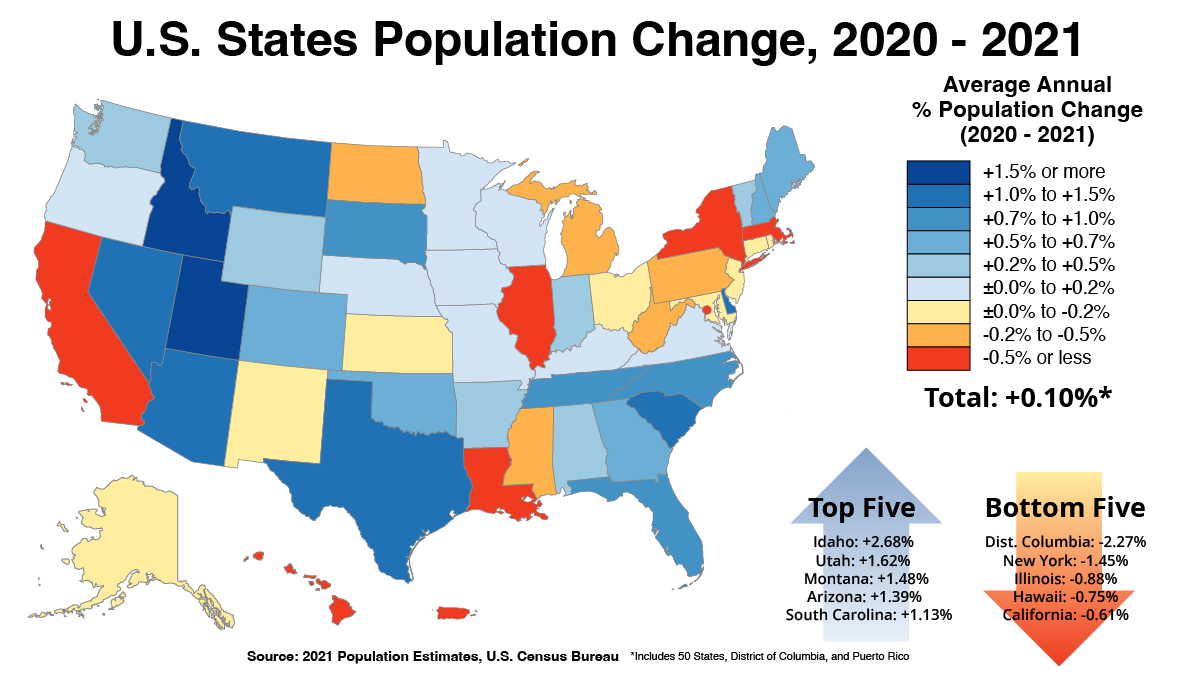
Geography is increasingly a factor in U.S. politics

This decline in blue America has accelerated since the pandemic, due to rising crime and the availability of remote work. Last year, New York, California and Illinois lost more people to outbound migration than all other states. Demographer Wendell Cox notes that the largest percentage loss of residents has occurred in big core cities such as New York City, Chicago and San Francisco. In contrast, population burgeoned in sprawling areas such as Phoenix, Dallas and Orlando.

The future of the GOP depends on the continued growth of such places, as well as the growth of suburbia nationwide. Between 2010 and 2020, 51 major metropolitan areas lost 2.7million net domestic migrants from their most central counties, while suburban counties gained two million people. The Midterms show that Republicans are gaining ground in these largely suburban areas – particularly in Florida, as well as suburban Phoenix, the outskirts of Atlanta, the Houston exurbs, largely suburban Nashville, the sprawling Virginia Beach area and suburban Detroit. Democrats, where they made gains yesterday, tended to be in places like California, where the Republican Party has all but ceased to exist.

Read the rest of this piece at Spiked.


Joel Kotkin is the author of The Coming of Neo-Feudalism: A Warning to the Global Middle Class. He is the Roger Hobbs Presidential Fellow in Urban Futures at Chapman University and Executive Director for Urban Reform Institute. Learn more at joelkotkin.com and follow him on Twitter @joelkotkin.

Chart: Abdullah Ali Abbasi via Wikimedia under CC 4.0 License.

https://joelkotkin.com/wp-content/uploads/2022/11/US-Population-change_2020-2021.png 675 1200 Joel Kotkin /wp-content/uploads/2017/01/jkotkin_logo.png Joel Kotkin2022-11-10 07:11:202022-11-09 14:26:04A Tale of Two Americas

West Coast Blues

November 8, 2022/in California, Politics, The Economy

Few regions have been more consistently Democratic than the West Coast. Even compared with the Northeast, where Republicans occasionally win governors’ offices, the appropriately named “left coast” has been adamantine in its progressivism. Republicans haven’t won statewide office in California in years; in Oregon, it’s decades. Washington has elected a Republican secretary of state, but she now serves in the Biden administration. And the region’s major cities are overwhelmingly blue.

Read more

https://joelkotkin.com/wp-content/uploads/2022/11/will-the-west-coast-blue-states-turn-red.png 675 1200 Joel Kotkin /wp-content/uploads/2017/01/jkotkin_logo.png Joel Kotkin2022-11-08 07:07:032022-11-07 14:16:38West Coast Blues

Biden, Trudeau Choose Green War on Oil and Gas Over Working Class

November 3, 2022/in Politics

Canadians, outside of dual citizens, can’t vote in America’s midterms, but the results may well shape the country’s trajectory in the years to come.

The current crisis around inflation, a probable recession, rising heating costs and electricity prices, with increases in Canada of upwards of 50 percent or more, as well soaring food prices are clearly shaped by global forces. But the economic crisis also has roots in the well-financed green movement’s war on fossil fuels. These turn out to be critical to such industries as manufacturing and logistics while the drive to ban natural gas based fertilizers constitutes a gun at the head at the farms that feed the world.

Read more

https://joelkotkin.com/wp-content/uploads/2022/11/biden-and-trudeau.jpg 675 1200 Joel Kotkin /wp-content/uploads/2017/01/jkotkin_logo.png Joel Kotkin2022-11-03 07:19:582022-11-10 18:11:15Biden, Trudeau Choose Green War on Oil and Gas Over Working Class

The Real American Divide

October 31, 2022/in Politics

Elections are never easy to predict. But whatever the outcome of America’s Midterms next month, it does seem certain that vast swathes of the American electorate will be largely ignored. In state after state, voters face a Hobson’s choice between abortion-banning, election-denying Trump loyalists on the one hand and Democrats embracing the Biden administration’s unpopular economic and cultural agenda on the other.

November’s election will introduce a new crop of politicians who are either themselves on the ideological extremes, or who at least feel compelled to placate their party’s most intemperate elements. A Republican victory in November seems set to continue this pattern: there are proposals for extreme abortion bans and calls for the impeachment of top administration officials, and there is also a growing personal focus on Biden’s family scandals and, of course, Trumpista election denial.

But instead of appealing to extremes, America should return to a simpler politics centered on what the Swedish sociologist Gunnar Myrdal calls ‘the American creed’. This, he explains, is Americans’ ‘abiding sense that every individual, regardless of circumstances, deserves fairness and the opportunity to realise [his or her] unlimited potential’. Given America’s ideological, regional and racial diversity, we can best address the ‘American dilemma’ by adopting pragmatism as a guiding philosophy.

America’s current ideological fixations are partly the result of the party primary system. Here the extremes tend to exercise more power, especially with the rise of ideologically purist Political Action Committees (PACs), which feed off discord and dysfunction. They prefer to focus on their opponents’ failings rather than their own ideas. Ironically, this negative partisanship has been made worse by the Democrats’ cynical support for far-right Republican candidates. On the grounds that an unpopular opponent would galvanise their own base, they supported Kari Lake in the Arizona primary, which Lake won in August. Now the Republican candidate for governor of Arizona, Lake, who is ahead in the polls, is accused by Democrats of being a ‘threat to democracy’.

These cabals of party activists and operatives thrive in conditions where the media – with good reason – are distrusted. Indeed, almost all major institutions, from corporations to the military, the FBI, the education sector and even churches have lost public support. This is made worse by petty tyrants like speaker of the house Nancy Pelosi, senate majority leader Charles Schumer and his Republican counterpart, Kentucky senator Mitch McConnell. Each demands Stalinist conformity in votes in the House, meaning that representatives must always parrot the same line, even if that damages their constituents.

Politicians’ ideological partisanship reflects a growing gap between the political class and the bulk of the population. Half of Democrats, for instance, still consider themselves moderate or conservative, while only 15 per cent see themselves as ‘very liberal’. Another study found that in US society as a whole, ‘traditional’ and ‘passive’ liberals outnumber the eight per cent who are ‘progressive activists’ by three to one. Meanwhile, there are almost six times as many ‘traditional conservatives’ and ‘moderates’ than ‘devoted’ right-wingers, who comprise just six per cent of the population. Overall, according to a Gallup poll last month, 43 per cent of Americans now identify as independent, which is more than those identifying as either Republican or Democrat.

So while most Americans are moderate and pragmatic, they are often stuck with two unpalatable alternatives. Fewer than 10 per cent identify as either ‘very conservative’ or ‘very liberal’. Yet, as University of Chicago political scientist Anthony Fowler notes, moderates ‘are silent in no small part because in political surveys, the public is often not given the opportunity to express its moderate views’.

Read the rest of this piece at Spiked.


Joel Kotkin is the author of The Coming of Neo-Feudalism: A Warning to the Global Middle Class. He is the Roger Hobbs Presidential Fellow in Urban Futures at Chapman University and Executive Director for Urban Reform Institute. Learn more at joelkotkin.com and follow him on Twitter @joelkotkin.

Photo: Tom Arthur via Flickr, under CC 2.0 License.

https://joelkotkin.com/wp-content/uploads/2022/10/moderate-voters-real-political-divide.jpg 675 1200 Joel Kotkin /wp-content/uploads/2017/01/jkotkin_logo.png Joel Kotkin2022-10-31 07:25:352022-11-03 09:07:21The Real American Divide

From Boris to Trump, Yesterday’s Men Won’t Go Away

October 28, 2022/in Politics

Boris Johnson may not be the UK’s next Prime Minister, but he could easily become the Tory choice after the party’s likely drubbing whenever the next general election happens. Or perhaps earlier, if the party disintegrates ahead of schedule once again.

Johnson’s return, although now delayed, will reflect a growing political tendency around the world to keep bringing back the old warhorses of bygone eras. Even in Israel, former prime minister Benjamin Netanyahu, 73, seems primed to return to the office he held for a record-breaking 15 years.

The most important retreads, however, are in the US, where the two likely presidential contenders are President Biden, who will be well over 80 at the time of the election, and Donald Trump, who is already 76 years old. Neither one of these figures are particularly popular — their approval ratings tend to be in the low 40s or below — but they have nonetheless captured much of their party apparatus.

The reasons for this phenomena are complex, but reflect a torpor in our political culture which, like Hollywood, feels more secure with reruns than original ideas. Well-known politicians, even ones like Donald Trump, benefit from constant news coverage that newcomers can only fantasise about. The big money people often follow the media and notoriety, and usually back candidates with significant name recognition.

President Biden, the ultimate political retread, epitomises this trend. He was virtually nobody’s favourite candidate in 2020 yet the oligarchs who dominate Democratic politics feared the rise of the openly socialist Bernie Sanders and his slightly less dogmatic rival Elizabeth Warren. In the end, party grandees and big money interests took the less risky option and picked the cognitively deficient ancient mariner from Delaware as the party candidate.

In the general election, Biden was a somewhat calmer alternative to the toxic Donald Trump. His campaign was simple: hide in the basement, say little or nothing of substance, and let Trump suck up the news cycle. But now, it look as though we are going to have a repeat. Trump still inspires huge amounts of support among the GOP base, and he can count on 30-40% of the vote. What we could witness, ultimately, is a rerun where both candidates are disliked by a strong majority of Americans.

Trump is a master of self-promotion and seeks to reduce everyone else to a footnote, something the Democrat-friendly media is sure to emphasise. This is not a good strategy in the midterms, in which the media will make Trump the issue rather than the clearly incompetent man occupying the White House, as Barack Obama has pointed out. On the other hand, when on the ballot Trump may serve as the best means for the Democrats, bearing the burden of an unraveling economy, to keep control of the White House.

Of course, not all retreads are from the Anglosphere. Xi Jinping, already 69, has essentially appointed himself dictator for life. In Brazil, Lula is likely to be re-elected — after serving in prison for corruption. Meanwhile, Vladimir Putin remains in office at the age of 70 and may stay there unless he is purged from within. It turns out that old politicians are hard to get rid of, whatever their politics, except by death.

This piece first appeared at UnHerd.


Joel Kotkin is the author of The Coming of Neo-Feudalism: A Warning to the Global Middle Class. He is the Roger Hobbs Presidential Fellow in Urban Futures at Chapman University and Executive Director for Urban Reform Institute. Learn more at joelkotkin.com and follow him on Twitter @joelkotkin.

Photo: Whitehouse45 via Flickr, in Public Domain.

https://joelkotkin.com/wp-content/uploads/2022/10/yesterdays-men-boris-and-donald.jpg 675 1200 Joel Kotkin /wp-content/uploads/2017/01/jkotkin_logo.png Joel Kotkin2022-10-28 07:25:402022-10-27 09:45:30From Boris to Trump, Yesterday’s Men Won’t Go Away

Ohio and the Battle for Populist America

October 19, 2022/in Demographics, Politics

This midterm year, in which many states have to choose between non-entities and the certifiably insane, Ohio is blessed by a real political dogfight. The Senate battle between representative Tim Ryan and Hillbilly Elegy author, JD Vance, is becoming one for the ages.

Read more

https://joelkotkin.com/wp-content/uploads/2022/10/ohio-senate-race.jpg 675 1200 Joel Kotkin /wp-content/uploads/2017/01/jkotkin_logo.png Joel Kotkin2022-10-19 07:28:252022-10-17 21:38:32Ohio and the Battle for Populist America

Three Paths to Despotism

October 10, 2022/in Politics, The Economy

“Democracy is at stake,” US President Biden told a gathering of Democratic Party governors on September 28th. His warning about the global spread of illiberalism followed the stunning gains made by populist parties in Sweden and Italy, the latter of which he mentioned directly. “We can’t be sanguine about what’s happening here either,” he added. Biden has already called much of his own domestic opposition “semi-fascist,” and fears of anti-democratic violence remain following the storming of the US Capitol on January 6th, 2020, by rioters attempting to overturn his own election.

Read more

https://joelkotkin.com/wp-content/uploads/2022/10/3-paths-to-despotism.jpg 675 1200 Joel Kotkin /wp-content/uploads/2017/01/jkotkin_logo.png Joel Kotkin2022-10-10 07:25:142022-10-13 14:46:26Three Paths to Despotism

What Really Divides America

October 4, 2022/in Politics

Reading the mainstream media, one would be forgiven for believing that the upcoming midterms are part of a Manichaean struggle for the soul of democracy, pitting righteous progressives against the authoritarian “ultra-MAGA” hordes. The truth is nothing of the sort. Even today, the vast majority of Americans are moderate and pragmatic, with fewer than 20% combined for those identifying as either “very conservative” or “very liberal”. The apocalyptic ideological struggle envisioned by the country’s elites has little to do with how most Americans actually live and think. For most people, it is not ideology but the powerful forces of class, race, and geography that determine their political allegiances — and how they will vote come November.

Read more

https://joelkotkin.com/wp-content/uploads/2022/10/democracy-watch.jpg 1358 2400 Joel Kotkin /wp-content/uploads/2017/01/jkotkin_logo.png Joel Kotkin2022-10-04 07:21:132024-11-20 08:17:39What Really Divides America

Environmentalism is a Fundamentalist Religion

September 20, 2022/in Politics

Today’s climate activists resemble nothing so much as a religious movement, with carbon the new devil’s spawn. The green movement is increasingly wedded to a kind of carbon fundamentalism that is not only not realistic but will reduce living standards in the West and around the world. And as with other kinds of religious fundamentalism, the climate hysteria is often overwrought and obviously so; a decade ago, the same activists predicted a planetary disaster by 2020 if the U.S. and China did not reduce their emissions by 80 percent—which of course never happened.

This approach is a losing one that reduces the effectiveness of the green lobby. What’s needed to combat climate change is a pragmatic approach based on adapting to real and verifiable dangers. And this starts with environmentalists acknowledging the limits of our ability to curb emissions in the short run.

This is not to cede the fight. The reality is what we do in the West means increasingly little. Today’s biggest emitters comes from China, which already emits more GHG than the U.S. and the EU combined, while the fast growth in emissions comes increasingly from developing countries like India, now the world’s third largest emitter. These countries have developed a habit of blaming climate change on the West, then openly seeking to exempt themselves from net zero and other green goals. And the West’s penchant for hyper-focusing on our own state or national emissions misses the reality of where the future problems are actually concentrated.

We aren’t just missing the forest for the trees, though. Under the green lobby’s current policies, our “war” against climate change is doomed to make things worse for most people, creating what economist Isabel Schnabel calls “greenflation.” Higher prices for energy and food, worsened further by the war in Ukraine, are already are forcing countries to adopt massive subsidies for food and gas. In the developing world, billions now face immiseration, malnutrition or starvation. And green targets of zero emissions only make this situation worse.

Residents of rich countries will also suffer from the rapid adoption of current green policies that are focused almost entirely on wind and solar. Germany, for example, suffered the highest electricity prices in the world before Russia’s war in Ukraine. In California, residents pay up to 80 percent above the national average for power. Reliance on wind power has made even Texas’ grid vulnerable.

The real winners from green policies are not the birds and the bees but tech oligarchs, the uncompetitive U.S. auto industry, and Wall Street.

Given our limited ability to meaningfully reduce emissions, more attention should be placed on adapting, something we’re actually good at. Since the beginning of the modern era, technology and science have been employed successfully to changes in temperature and precipitation. In the 1700s, people dealt with a colder climate by planting potatoes, which thrive in cooler weather. They also learned to use waterpower, wind and most critically fossil fuels, which made life bearable in the icy cities of the north and, later, with air conditioning, in the brutally hot south.

Read the rest of this piece at Newsweek.


Joel Kotkin is the author of The Coming of Neo-Feudalism: A Warning to the Global Middle Class. He is the Roger Hobbs Presidential Fellow in Urban Futures at Chapman University and Executive Director for Urban Reform Institute. Learn more at joelkotkin.com and follow him on Twitter @joelkotkin.

Photo: Stefan Müller via Flickr under CC 2.0 License.

https://joelkotkin.com/wp-content/uploads/2022/09/climate-fundamentalism.jpg 675 1200 Joel Kotkin /wp-content/uploads/2017/01/jkotkin_logo.png Joel Kotkin2022-09-20 07:24:142022-09-19 16:36:21Environmentalism is a Fundamentalist Religion

There Are Dark Days Ahead for the Jewish Diaspora

September 9, 2022/in Demographics, Politics, Religion

Jews around the world, particularly outside the fortress of Israel, are threatened in a way not seen since the 1940s. A fundamentally unstable world, with rising class and racial animus, creates a perilous environment for history’s favourite target, as seen previously in such periods as the fall of Rome, the Crusades, the Black Death and the Great Depression of the 1930s.

Read more

https://joelkotkin.com/wp-content/uploads/2022/08/jews-at-jewish-wedding.jpg 675 1200 Joel Kotkin /wp-content/uploads/2017/01/jkotkin_logo.png Joel Kotkin2022-09-09 07:25:562022-09-07 16:38:13There Are Dark Days Ahead for the Jewish Diaspora
Page 26 of 80«‹2425262728›»
Search Search

Subscribe to Feed

Subscribe to RSS   follow us in feedly

Recent Articles

  • I’d Like to Believe California Can Be Saved from the Left
  • The Strange Afterlife of Fascism
  • Steve Hilton’s Rise Won’t Kill California Progressivism
  • The Anti-AI Backlash is Building Against Tech Oligarchs Playing God
  • SpaceX IPO Will Bolster American Tech Supremacy

Joel has spoken at many leading universities, business groups, government organizations and more.

INVITE JOEL TO SPEAK

STAY CONNECTED

Join the conversation at Twitter
or Facebook. Visit our YouTube
channel or subscribe to RSS
to read our latest articles.

      Subscribe to RSS  follow us in feedly

Recent Articles

  • California has been a one-party state for awhile; can that change?
    I’d Like to Believe California Can Be Saved from the LeftJune 8, 2026 - 11:45 am
  • The Strange Afterlife of FascismJune 5, 2026 - 11:40 am
  • Steve Hilton speaking at an event for conservative officials
    Steve Hilton’s Rise Won’t Kill California ProgressivismJune 3, 2026 - 11:40 am
  • The Anti-AI Backlash is Building Against Tech Oligarchs Playing GodJune 1, 2026 - 11:40 am

Topics

  • Books
  • California
  • Demographics
  • In the News
  • Podcast
  • Politics
  • Religion
  • Reports
  • Rural Policy
  • The Economy
  • Urban Affairs
© Copyright – Joel Kotkin | Site Admin
  • About
  • Media
  • Books
  • Articles
  • Podcast
  • Speaking
  • Contact
Scroll to top Scroll to top Scroll to top