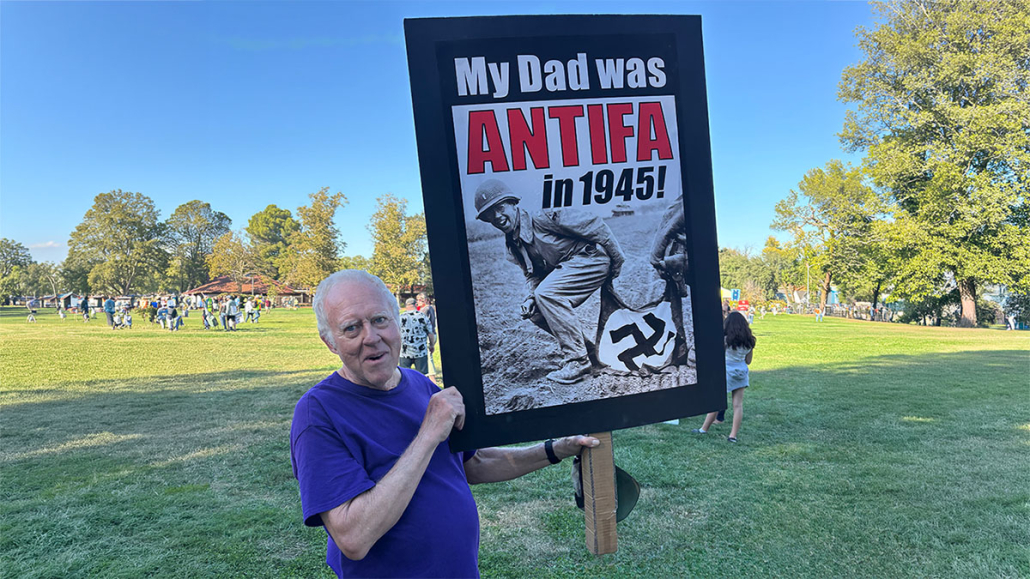
The Strange Afterlife of Fascism
There’s hardly a ruler in the world who would identify as fascist, but if you trust the mainstream media, you will assume fascism is on the march. Mentions of the term have skyrocketed ever since Donald Trump emerged from the land of chandeliers; fascist mentions on cable reached unprecedented levels in the run-up to the 2024 election. Now, almost anything Trump does – from cracking down on illegal immigration to proposing construction of a victory arch – is seen by the Washington Post and others as fascist.
Tellingly, the term has not just been applied to Trump. It has, for decades, been slapped on almost everyone progressives don’t like. George W. Bush, John McCain, and even meek Mitt Romney have all been called the F-word. Same goes for the former reality TV star Spencer Pratt, who is running for mayor in Los Angeles.
The net has been widened by using the term to describe the millions of people who support such figures. One Canadian economist claims to have identified 1,000 words – including rebirth, liberalism, ethnic, and Jewry – he says are indicative of “fascist jargon.”
Given that fascism’s heyday was from the early 1920s until the end of World War II and that the last fascist leader of a major country, Spanish dictator Francisco Franco, died in 1975, the endurance of this term may seem surprising. This is especially true in the American context, given that fascism – unlike socialism –never gained a foothold here, largely remaining a European and Latin American phenomenon. This pattern is also seen in the developing world, particularly in the Middle East, while China may be the world’s largest power that follows a script that Mussolini would follow.
Still, fascism is invoked so often, and with such force, the question arises: Is it or anything like it already here or on the near horizon? To begin to answer this question, this reporter traveled to the birthplace of fascism, Italy, to explore what the ideology actually was before examining whether its key features remain forceful drivers of contemporary politics. It reveals both that leftists who issue the loudest warnings about rising fascism increasingly exhibit many of its characteristics more than those they accuse – and that the larger fascist threat may not be coming from people but machines.
What Was Fascism?
Historians agree that Italian dictator Benito Mussolini was the first major fascist to rise to power, taking control of his country in the aftermath of World War I. The son of a socialist blacksmith, Mussolini viewed himself as a “revolutionary” who would transform a ravaged nation. While fascism is often identified with the political right, it was a call to collective action: The word itself comes from the Latin fasces, which suggests how a bundle of rods is far stronger than a single stick. The earliest modern use was from socialist radicals in Sicily. Historians would also note that it was marked by ultra-nationalism, state control of thought and economic life, adulation of an all-powerful, and totalizing ideology covering every aspect of human existence.
Except for the ultra-nationalism, it was similar to the communism of Lenin and even more so of Stalin.
Mussolini later described fascism as an ”organized, concentrated, authoritarian democracy.”
In today’s Italy, some outlets like The Guardian label the present government of Giorgia Meloni as the doyenne of what it describes as “neo-fascism.” They see in her politics a savvy, gradualist way to restore the Mussolini-era patriarchy and strong, controlling state.
Although her party has its roots in a political descendant of the fascist regime, there is little evidence of what historian Simonetta Falasca-Zamboni has described as “fascist spectacle.” There are few Meloni posters, much less statues in Rome or elsewhere. She does not hold the kind of massive show-of-strength rallies that Mussolini and Hitler specialized in. Unlike Mussolini, she has no cadre of violent “Blackshirts” to impose the party’s will.
Read the rest of this piece at Real Clear Investigations.
Joel Kotkin is the author of The Coming of Neo-Feudalism: A Warning to the Global Middle Class. He is the Roger Hobbs Presidential Fellow in Urban Futures at Chapman University and and directs the Center for Demographics and Policy there. He is Senior Research Fellow at the Civitas Institute at the University of Texas in Austin. Learn more at joelkotkin.com, follow him on Substack and Twitter @joelkotkin.
Homepage photo credit: Stephan T., via Flickr under CC-By-NC-SA 4.0 license.