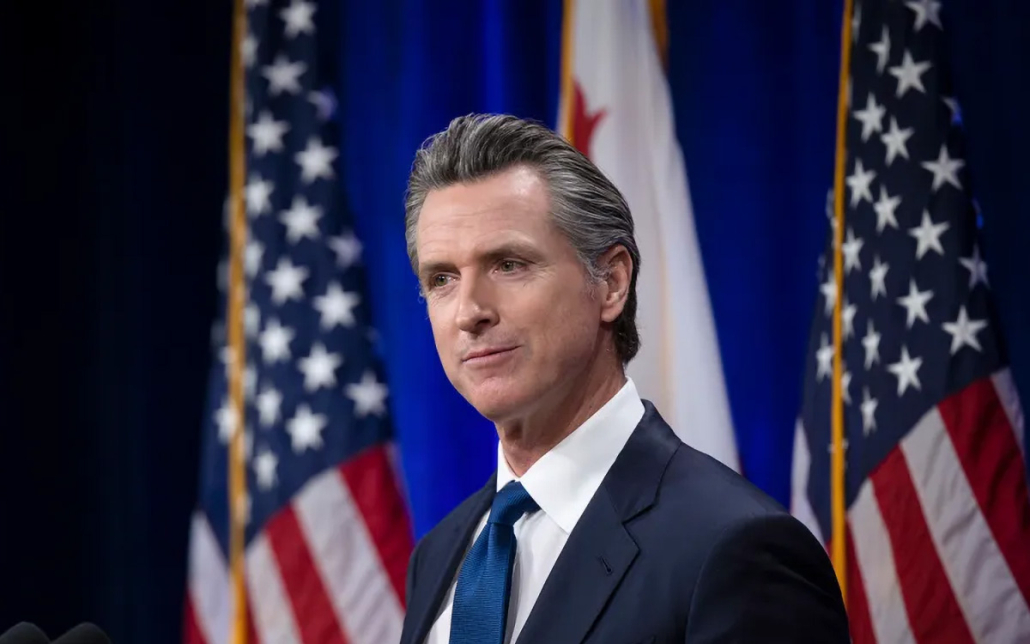
Is Gavin Newsom’s White House Dream Fading?
Gavin Newsom is, as usual, indulging in a public relations blitzkrieg. But some suspect he may be losing his grip on his real ambition: a move to the White House.
Recent polling suggests that Governor Brylcreem is losing ground to California’s other potential presidential contender, Kamala Harris. Indeed, as both have used book tours to boost their profiles, it is Harris — not Newsom — who appears to be extending her lead in early Democratic presidential polling.
That may be partly because Harris, after a long period of relative silence, is increasingly starting to sound like a candidate again. Unlike Newsom, she also does not have to defend a record as governor of California that is at best mixed, and which offers plenty of ammunition for potential rivals. Her bigger challenge will be distancing herself from the unpopular Biden years and her role within them.
To be sure, California continues to generate enormous wealth from a handful of dominant tech companies. But the state is also plagued by some of the country’s worst economic indicators: one of the highest poverty rates, sluggish job growth, high unemployment, an extraordinarily expensive housing market and low literacy rates.
More recently, a series of corruption allegations have reached Newsom’s inner circle, including his former chief of staff Dana Williamson. Even his attacks on Trump have begun to lose their novelty, as more aggressive voices from the party’s rising activist Left increasingly shape Democratic messaging. The DSA wing appears less concerned by the political reality that Democrats must distance themselves from parts of the neo-socialist agenda if they hope to win back some Trump voters.
Like Harris, Newsom has sought to accommodate the party’s socialist wing, describing it as a legitimate faction within the Democratic “big tent”. But he is burdened by the perception that he is a wealthy, establishment figure: white, male and associated with California’s elite class. More importantly, he has resisted proposals such as a wealth tax, which won’t play well with the Democratic grassroots.
Newsom understands that a wealth tax could carry major risks for California’s top-heavy economy, where a small number of wealthy individuals and companies provide a disproportionate share of tax revenue. That money helps fund the state’s expansive welfare programs, which in turn sustain the political loyalties of public-sector workers and beneficiaries.
The Left’s hostility towards AI and data centers creates another dilemma. Software remains the primary engine of California’s tech economy, while much of the hardware manufacturing base has moved elsewhere. Calls from the activist Left to restrict data centers amount to a direct challenge to the AI ambitions of the very tech industry that forms Newsom’s core constituency.
Balancing the demands of the activist Left will be difficult for a governor whose primary concern must remain fiscal stability. If the AI boom that has helped drive markets begins to falter, California could find itself exposed. The state’s revenues have historically fallen sharply during stock market downturns, as seen after the dotcom crash, the 2008 financial crisis and the 2022 market slump. If wealthy residents and major companies continue to leave, California could face a fiscal crisis — a nightmare scenario for Newsom heading into a presidential campaign. A potential departure of Paramount, amid its planned merger with Warner Bros, would add to those concerns.
Read the rest of this piece at UnHerd.
Joel Kotkin is the author of The Coming of Neo-Feudalism: A Warning to the Global Middle Class. He is the Roger Hobbs Presidential Fellow in Urban Futures at Chapman University and and directs the Center for Demographics and Policy there. He is Senior Research Fellow at the Civitas Institute at the University of Texas in Austin. Learn more at joelkotkin.com, follow him on Substack and Twitter @joelkotkin.