Feudal Future Podcast – The Crisis on Labor
On this episode of Feudal Future, hosts Joel Kotkin and Marshall Toplansky are joined by Robyn Domber, Lane Windham and Michael Bernick to discuss the crisis on labor shortages.

On this episode of Feudal Future, hosts Joel Kotkin and Marshall Toplansky are joined by Robyn Domber, Lane Windham and Michael Bernick to discuss the crisis on labor shortages.
President Joe Biden has nominated Los Angeles mayor Eric Garcetti as ambassador to India. Assuming the Senate confirms him, Garcetti, who would leave office early (his second term ends in December 2022), might find India familiar in certain respects. Like Mumbai or Delhi, Los Angeles now has massive homeless encampments throughout the city, even increasingly in posh neighborhoods like Brentwood and throughout the middle-class strongholds of the San Fernando Valley. Late last week, as Garcetti prepared to leave town, homeless advocates, angered by a city ordinance against indiscriminate camping on city streets, vandalized Getty House, the mayor’s official residence.
America’s cities face an existential crisis that threatens their future status as centers of culture, politics, and the economy. Many urban advocates continue to delude themselves that U.S. cities are about to experience a massive post-pandemic return to “normal.” But the disruptive technological, demographic, and social changes of recent times are more likely to upend the old geographic hierarchy than to revive it.
A representative New York Times article from July 12 denied that the pandemic has impacted dense urban areas in particular, and blamed negative attitudes toward cities instead on what it called “alluring” anti-urban attitudes. Perhaps urban advocates need to ditch their own attitudes and confront reality (and the statistical evidence): Many key problems facing our core cities—growing social instability, rising crime, out-migration, increasingly radicalized politics, high costs, and tight regulation—predate the pandemic, and are not likely to go away easily. Clever proselytizing by urban media likely won’t be enough to convince Americans liberated by the efficacy of remote work to eventually return.
To survive and thrive, American cities need to reinvent urbanity by returning to a more diverse economy concentrated not in the central districts but in neighborhoods stretched across the city. Such a shift can only take place if the trajectory of urban politics changes. Some cities, notes Seth Barron, author of the newly published The Last Days of New York, have been captured by “an equity oriented social ideology” paid for by real estate interests and public sector unions, and backed by mainstream media and nonprofits, that has proven profoundly self-destructive. Outside New York, political leadership in cities like Portland, Oregon; Minneapolis; Seattle; and San Francisco continue to work assiduously to restrain law enforcement, even in the face of rising crime.
There appears to be a growing pushback against the progressive urban agenda, whose journalistic promoters often minimize social disorder. Defunding the police has not turned out to be a progressive success; the five cities that reduced their police budgets the most in 2020—Austin, Texas; New York; Minneapolis; Seattle; and Denver—have seen murders spike over the past year, well above the national average. Having partially gone down the path of defunding in 2020, New York, Baltimore, and Oakland, California, have now taken steps to restore some police funding. In ultraliberal San Francisco, the vast majority of city residents want more police; almost half are considering leaving the city, citing social disorder as a key reason. Residents of the fashionable Capitol Hill area in Seattle are erecting barriers to keep out the homeless.
But if the urban gentry are upset, the real shift is further down the social pecking order. The surprising victory of ex-cop Eric Adams as New York’s next mayor took place amid a surge in violent crime, garnering support for his centrist, pro-police platform from the city’s minority voters. My colleague Charles Blain, president of the Urban Reform and Urban Reform Institute in Houston, noted that opposition to “defunding” has come primarily from African American and Latino politicos in his city, while support seems to stem mostly from affluent white liberals.
Political divides within cities increasingly defy traditional definitions of right and left. There’s a growing conflict between those largely dependent on public schools, spaces, and transit, and those free of the need for public services due to their ability to live close to work, send their kids to private schools, or choose not to have kids at all. Much of the base of urban radicalism has shifted from minority communities to the ultrawoke, largely white, educated left.
Yet progressives, due in part to small voter turnouts, still dominate representative bodies like the New York City Council; the newly elected Manhattan district attorney follows the left’s program of low-intensity crime enforcement. In Buffalo and Pittsburgh, recent elections have favored far-left candidates. In Philadelphia, a recent attempt to remove the George Soros-backed District Attorney Larry Krassner failed miserably, despite rising crime.
The current urban trajectory is downwind of demographics. Despite the media hurrahs of a massive “back to the city” movement, Americans have been moving in the opposite direction for most of the past decade. Since 2012, suburbs and exurbs have accounted for about 90% of all metropolitan growth. The rate of growth in America’s biggest and most expensive cities began to decline as early as 2015, and the population shift to suburbs, exurbs, and smaller cities has accelerated, something evident well before the pandemic.
Read the rest of this piece at Tablet Magazine.
Joel Kotkin is the author of The Coming of Neo-Feudalism: A Warning to the Global Middle Class. He is the Presidential Fellow in Urban Futures at Chapman University and Executive Director for Urban Reform Institute. Learn more at joelkotkin.com and follow him on Twitter @joelkotkin.
Photo: JJ, via Flickr under CC BY-NC-ND 2.0 License.
On this episode of Feudal Future, hosts Joel Kotkin and Marshall Toplansky are joined by Doug Holte, Kate Lister, and Andrew Segal to discuss work post-pandemic.
In Europe, North America, Oceania and East Asia, the COVID-19 pandemic has been a tragic, wrenching experience, creating more depressed and divided societies. Yet, as we have been gazing obsessively at our own problems, a spectre infinitely worse is emerging in the most populous, fastest growing and least resilient parts of the world.
COVID has caused a deep crisis in the already suffering developing world, which contains nearly half of all humanity. And this will have serious implications for the future of the world economy and political order.
Initially, COVID was something of a rich country’s disease. It started in industrial China and spread to places like the United States, Italy and the United Kingdom. But now none of the wealthiest countries falls within the top 10 worst-hit countries in terms of Covid deaths per capita. In the US, COVID has gone from the leading cause of death to seventh place in just over a year.
According to Bloomberg, the countries now most resilient to COVID and its variants are all among the richest – the United States, New Zealand, Israel, France, the UK and Spain, along with some wealthier East Asian countries, including China. In contrast, the pandemic rages on in Latin America and the backwaters of Eastern Europe. Impoverished Peru has been particularly hard hit, recording a COVID fatality rate twice that of any other country.
At the bottom of the list, according to Bloomberg, lies Argentina, the Philippines, India, Malaysia, Indonesia, Colombia and Pakistan, where on average just five per cent of the population have been vaccinated. We may be seeing the fruits of what the Nation describes as ‘a gargantuan north-south vaccination gap’.
By June this year, the US and Britain had jabbed half of their populations, and the rest of the EU had jabbed a third. In contrast, the Democratic Republic of Congo, Ethiopia, Nigeria, South Sudan, North Sudan, Vietnam and Zambia had vaccinated between 0.1 per cent and 0.9 per cent of their populations. This is a world lurching towards vaccine apartheid.
Indeed, given the fear COVID-19 instills in people, developing countries in which infections are rife could become like no-go areas for Westerners – places that Western businesses avoid, except to acquire raw materials, such as the minerals that are critical to meeting the climate goals of Western countries.
Even before the pandemic, many economies in the developing world were experiencing difficulty accessing world credit markets, and that access will likely now worsen. Vaccination apartheid will exacerbate pre-existing problems. For example, according to 2019 data from the World Bank, youth unemployment was approaching 25 per cent in Turkey, India and Iran. In South Africa, it was over 55 per cent. Already high levels of youth unemployment will become much higher.
Read the rest of this piece at Spiked.
Joel Kotkin is the author of The Coming of Neo-Feudalism: A Warning to the Global Middle Class. He is the Presidential Fellow in Urban Futures at Chapman University and Executive Director for Urban Reform Institute. Learn more at joelkotkin.com and follow him on Twitter @joelkotkin.
Hügo Krüger is a Structural Engineer with working experience in the Nuclear, Concrete and Oil and Gas Industry. He was born in Pretoria South Africa and moved to France in 2015. He holds a Bachelors Degree in Civil Engineering from the University of Pretoria and a Masters degree in Nuclear Structures from the École spéciale des travaux publics, du bâtiment et de l’industrie (ESTP Paris). He frequently contributes to the South African English blog Rational Standard and the Afrikaans Newspaper Rapport. He fluently speaks French, Germany, English and Afrikaans. His interests include politics, economics, public policy, history, languages, Krav Maga and Structural Engineering.
Photo: Dennis Jarvis, via Flickr under CC 2.0 License.
Some longtime Californians view the continued net outmigration from their state as a worrisome sign, but most others in the Golden State’s media, academic, and political establishment dismiss this demographic decline as a “myth.” The Sacramento Bee suggests that it largely represents the “hate” felt toward the state by conservatives eager to undermine California’s progressive model. Local media and think tanks generally concede the migration losses but comfort themselves with the thought that California continues to attract top-tier talent and will remain an irrepressible superpower that boasts innovation, creativity, and massive capital accumulation.
Reality reveals a different picture. California may be a great state in many ways, but it also is clearly breaking bad. Since 2000, 2.6 million net domestic migrants, a population larger than the cities of San Francisco, San Diego, and Anaheim combined, have moved from California to other parts of the United States. (See Figure 1.) California has lost more people in each of the last two decades than any state except New York—and they’re not just those struggling to compete in the high-tech “new economy.” During the 2010s, the state’s growth in college-educated residents 25 and over did not keep up with the national rate of increase, putting California a mere 34th on this measure, behind such key competitors as Florida and Texas. California’s demographic woes are real, and they pose long-term challenges that need to be confronted.
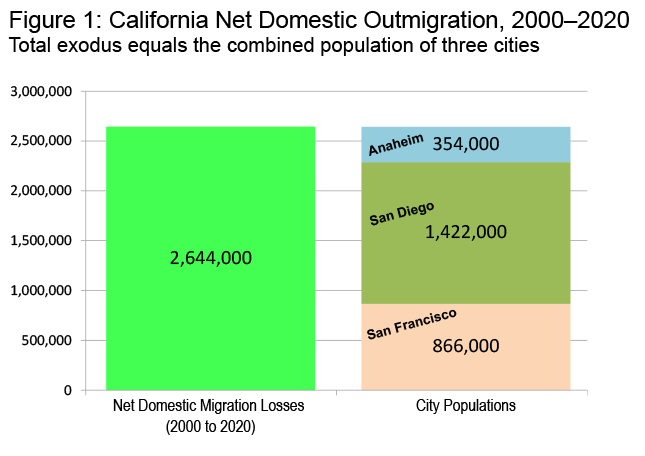
Source: Derived from U.S. Census Bureau Estimates
The state has suffered net outmigration in every year of the twenty-first century, but its smallest losses occurred in the early 2000s and the years following the Great Recession, when housing affordability was closer to the national average. Home prices have risen since then—and so have departures. Between 2014 and 2020, net domestic outmigration rose from 46,000 to 242,000, according to Census Bureau estimates.
The outmigration does not seem to have reached a peak. Roughly half of state residents, according to a 2019 UC Berkeley poll, have considered leaving. In Los Angeles, according to a USC survey, 10 percent plan to move out this year. The most recent Census Bureau estimates show that California started falling behind national population growth in 2016 and went negative for the first time in modern history last year.
The comforting tale that only the old, bitter, and uneducated are moving out simply does not withstand scrutiny. An analysis of IRS data through 2019 confirms that increasing domestic migration is not dominated by the youngest or oldest households. Between 2012 and 2019, tax filers under 26 years old constituted only 4 percent of net domestic outmigrants. About 77 percent of the increase came among those in their prime earning years of 35 to 64. In 2019, 27 percent of net domestic migrants were aged 35 to 44, while 21 percent were aged 55 to 64. (See Figure 2.)
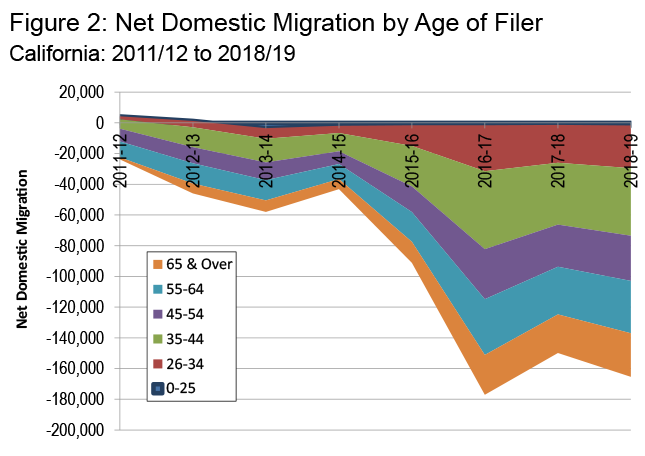
Source: IRS data
To be sure, the largest increase in net domestic migration was among those aged 65 and over. But the second-largest increase came in the 25 to 34 categories—with the state’s exorbitantly high cost of living the likely culprit.
Read the rest of this piece at City Journal.
Joel Kotkin is the author of The Coming of Neo-Feudalism: A Warning to the Global Middle Class. He is the Presidential Fellow in Urban Futures at Chapman University and Executive Director for Urban Reform Institute. Learn more at joelkotkin.com and follow him on Twitter @joelkotkin.
Wendell Cox is principal of Demographia, an international public policy firm located in the St. Louis metropolitan area. He is a founding senior fellow at the Urban Reform Institute, Houston, a Senior Fellow with the Frontier Centre for Public Policy in Winnipeg and a member of the Advisory Board of the Center for Demographics and Policy at Chapman University in Orange, California. He has served as a visiting professor at the Conservatoire National des Arts et Metiers in Paris. His principal interests are economics, poverty alleviation, demographics, urban policy and transport. He is co-author of the annual Demographia International Housing Affordability Survey and author of Demographia World Urban Areas.
Photo: Beatrice Murch, via Flickr under CC 2.0 License
These are times, to paraphrase Thomas Paine, that try the souls of American optimists. A strain of insane ideologies, from QAnon to critical race theory, is running through our societies like a virus, infecting everything from political life and media to the schoolroom. Unable to unite even in the face of COVID-19, the country seems to be losing the post-pandemic struggle with China while American society becomes ever more feudalized into separate, and permanently unequal, classes.
The COVID-19 pandemic has left pain and tragedy in its wake. But it has also created a unique opportunity to address the country’s persistent class divides, thanks to a persistent lack of labor resulting from the pandemic. In a world economy that has seen labor’s share of income drop for generations, this labor shortage could provide some restored leverage for both white and blue collar workers.
What happens in California matters well beyond its borders. The Golden State’s cultural and technological influence on America, and the world, now could provide the nation’s next political template.
What California is creating can be best described as oligarchic socialism, a form of collectivism that combines hierarchy with “equity,” regulation with oligopoly, and progressive intentions with feudal results. Read more
In recent history, the United States has arguably never been so divided — but not in the way you might think. Yes, the country has been split by the culture wars, with their polarising focus on race and gender. But behind the scenes, another conflict has been brewing; shaped by the economics of class, it has created two Americas increasingly in conflict.
Join the conversation at Twitter
or Facebook. Visit our YouTube
channel or subscribe to RSS
to read our latest articles.