Blue Collar Workers Are Our Only Hope
Amid all the hysteria, technological wreckage and gallons of spilt ink, artificial intelligence’s most potent legacy is yet to be discerned. As we enter the fourth industrial revolution, everyone from the World Economic Forum’s Klaus Schwab to 61% of Americans believe that AI poses a serious threat to humanity’s future. Such charged rhetoric, however, masks a more serious shift: the way in which it will accelerate the feudalisation of the West, concentrating power in the few large firms that seem destined to dominate the field.
AI’s problems start at the top. Unlike the internet, which spawned a number of independent companies (including Google and Microsoft), AI seems to be controlled by existing tech giants, which are investing heavily in these new firms. ARM, for instance, the British-based chip designer whose IPO last week set Wall Street aflutter, is garnering huge investments from other Big Tech firms, including Nvidia, Intel, AMD and Apple. Elsewhere, Open AI’s largest investor is Microsoft, while DeepMind was acquired by Google in 2014.
This pattern of collaboration between giants and upstarts suggests that the next tech revolution seems poised to empower the existing hierarchy. It also threatens the prospects of the classes below. Big Tech and venture capital executives such as Reid Hoffman promise that AI will serve the cause of “elevating humanity”, despite potentially wiping out hundreds of millions of jobs worldwide. Indeed, according to McKinsey, at least 12 million Americans will be forced to find new work by 2030. In other words, AI looks destined to warp our class structure in a similar way to feudalism, turning what has been a collection of Roman citizens into serfs.
But is this the entire story? Historically, humans have performed analytical tasks manually. They may have created tools, such as spreadsheets and surveys, to help them. But the tasks of optimising businesses have largely lain in the hands of human analysts who spend their days collecting data on the performance of businesses and markets. In the last phase of technological development, jobs for these “symbolic analysts” exploded: in the US, the number of workers in occupations requiring average to above-average education, training and experience increased from 49 million in 1980 to 83 million in 2015. Yet these tasks are now running into a buzzsaw with AI, whose underlying premise is that machines can learn to detect patterns and changes better than human beings.
In his bestselling book AI Superpowers, Kai Fu Lee, a former Google and Microsoft boss who now runs one of the world’s most prolific AI venture funds, proposed a two-dimensional view of the future of work. His key thesis: that the social nature of a job and the discretionary nature of a job will be the key factors underlying AI’s impact. If, for instance, a job is highly formulaic and has few discretionary decisions, and people perform their tasks with little social interaction, AI is likely to displace it. So, while the CEO of an insurance company might be safe from being displaced by AI, one of his analysts is not.
And this is where the nuance is often lost. According to the US Labor Department, AI and automation could impact as many as many as 90 million American workers, with warehouse workers among the most prominent losers. What will really alter class relations, however, is the impact on more professional jobs. They have been the ascendent class for the last two generations, growing at an average annual rate of 2.2% since 2001 — well above the 0.4% annual rise for total employment. But whereas the computer revolution was a boon to those working as programmers and market researchers, AI does the job for them, often with more speed and accuracy. As Rony Abovitz, one of the pioneers of virtual reality and AI, has observed: “It’s the end of the white-collar knowledge work.”
In such a world, it is not hard to envisage a new kind of class conflict that extends beyond the traditional Marxist conflict between low-wage workers and better-educated owners. More than 82% of millennials fear AI will reduce their pay, and they are right to be worried. “We may be at the peak of the need for knowledge workers,” Atif Rafiq, a former chief digital officer at McDonald’s and Volvo, recently warned. “We just need fewer people to do the same thing.” As if to illustrate his point, tech firms such as Meta and Lyft have already announced major cutbacks in their white-collar workforce, while IBM has paused hiring to assess how many mid-level jobs can be replaced by AI.
Read the rest of this piece at UnHerd.
Joel Kotkin is the author of The Coming of Neo-Feudalism: A Warning to the Global Middle Class. He is the Roger Hobbs Presidential Fellow in Urban Futures at Chapman University and Executive Director for Urban Reform Institute. Learn more at joelkotkin.com and follow him on Twitter @joelkotkin.
Marshall Toplansky is a widely published and award-winning marketing professional and successful entrepreneur. He co-founded KPMG’s data & analytics center of excellence and now teaches and consults corporations on their analytics strategies.
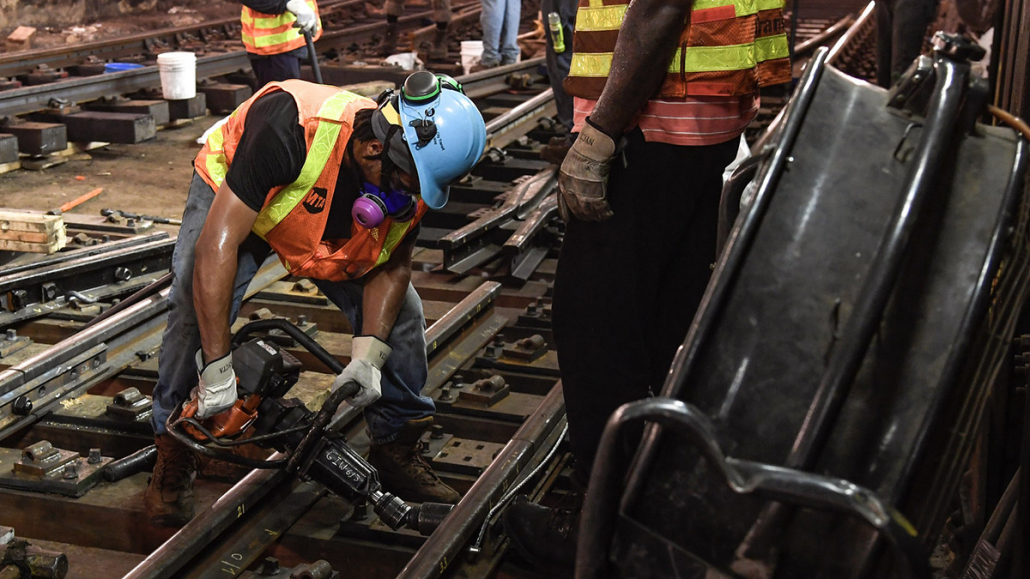
Homepage photo: Transportation workers via Flickr under CC 2.0 License.


 Kenu Lund, used under CC 2.0 License