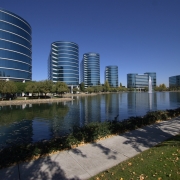
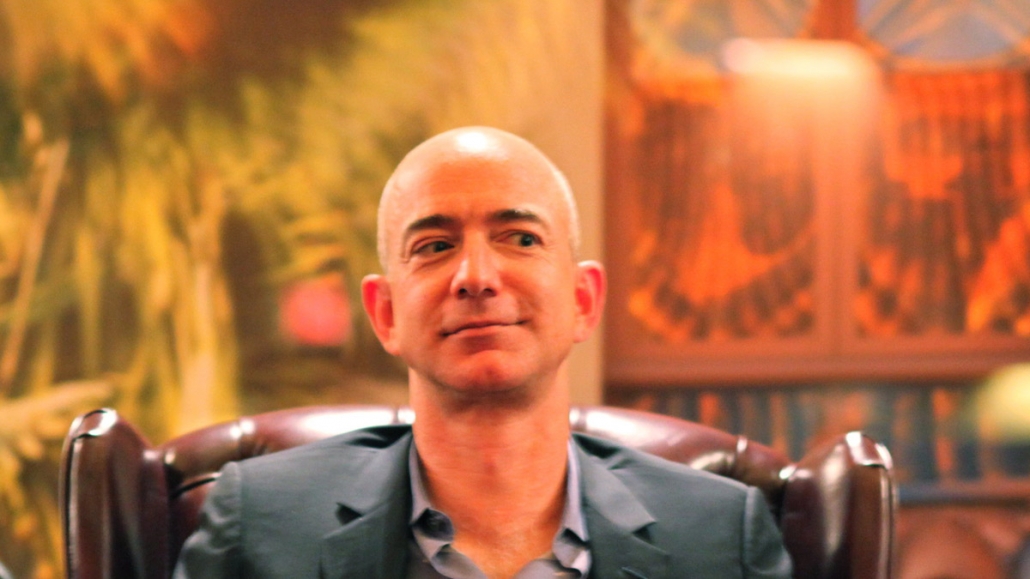
 Steve Jurvetson, used under CC 2.0 License
Winners and Losers: The Global Economy After COVID
The COVID-19 pandemic has transformed the world economy in ways that will be debated by pundits and future historians for decades to come. Yet, as hard as it is to predict a disrupted future accurately, the pandemic (not to mention its probable successors) looks likely to produce clear economic winners and losers. The top digital companies—Amazon, Apple, Tencent, Microsoft, Google, Facebook, Ant, Netflix, and Hulu—have thrived during quarantines and the ongoing dispersion of work. These are the most obvious winners in what leftist author Naomi Klein has called a “Screen New Deal” that seeks to create a “permanent and profitable no-touch future.” Since 2019, Facebook, Apple, Amazon, Microsoft, and Google have added over two-and-a-half trillion dollars to their combined valuation, and all enjoyed record breaking profits in 2020.
But it’s not just the tech oligarchs who have benefited from the pandemic disruption. Companies that keep the basic economy functioning—firms dealing in logistics, for example, or critical metals or food processing—have become, if anything, even more important. With the shipping supply chain disrupted due to the pandemic, logistics giant Maersk is set to increase its inland-based operation with the acquisition of the Swiss-based broker KGH Customs Services. The company reported its best quarter ever in the first quarter of 2021, launching a $5 billion share buyback scheme. And although the developing world has been hit hard by declines in tourism and investment, mining giants such as Glencore are investing billions to challenge China’s market dominance in rare earth minerals. The global market for cobalt is expected to double by 2025 and has launched a new “scramble for Africa,” which is also raising moral questions about whether or not the green oligarch’s love of the planet outweighs human rights abuses such as the practice of child labor in the Democratic Republic of Congo.
Even some high street businesses which have taken major hits are finding new niches. Many small businesses may never return to pre-COVID levels, as people have become used to the convenience of online purchases. Nevertheless, some are finding new uses for redundant malls, and have discovered new ways to reach more customers using social media and technology. Lower property prices are also opening up potential opportunities for entrepreneurs in pricey places such as Manhattan, San Francisco, or London. Pestilence re-shapes economies.
In his 2017 book The Fate of Rome: Climate, Disease, and the End of an Empire, historian Kyle Harper argues that plague, as well as climate change, undermined the Roman empire, creating conditions that boosted the barbarian warlords who would later become the Medieval aristocracy. The lethal plagues of the Middle Ages likewise disrupted the great Mongol empire, at the time the largest in history, and in conjunction with cooling temperatures, undermined the stability of the great Silk Road and ended the Pax Mongolica. This opened the door to the Age of Exploration and Europe’s maritime conquest of the world. Within Medieval Europe, the Black Death killed as much as 40 percent of the population, but also precipitated the rise of the Third Estate, and in some places raised wages for scarce labor. “People were fewer,” noted historian Barbara Tuchman, “but they ate better. The pandemic also led to greater emphasis on long-distance navigation.”
During the current crisis, disintermediation has been the primary driver of the post-pandemic economy. The novel coronavirus forced businesses to adapt quickly to new circumstances, and as with all economic crises, created winners and losers. The lockdowns accelerated the use of digital technology for work, retail, and entertainment. This has not only helped the big firms but also produced a whole crop of new startups, many of which address the shift to online work. The tech oligarchies now face competition from decentralized networks based on blockchain technology which is less vulnerable to domination by giant firms with algorithms that are designed to eliminate the incentive structures that lead to central node control and promote monopolistic behavior. Domains such as Lokinet, Ethereum, Odysee, and Urbit seek to give users ownership of their own data. Even Google’s near-monopoly of web browser supremacy is set to be challenged by data-privacy-conscious alternatives such as DuckDuckGo, which has seen a 62 percent growth in search results in 2020. Users are clearly becoming more conscious of privacy and data ownership.
Read the rest of this piece at Quillette.
Joel Kotkin is the author of The Coming of Neo-Feudalism: A Warning to the Global Middle Class. He is the Presidential Fellow in Urban Futures at Chapman University and Executive Director for Urban Reform Institute. Learn more at joelkotkin.com and follow him on Twitter @joelkotkin.
Hügo Krüger is a Structural Engineer with working experience in the Nuclear, Concrete and Oil and Gas Industry. He was born in Pretoria South Africa and moved to France in 2015. He holds a Bachelors Degree in Civil Engineering from the University of Pretoria and a Masters degree in Nuclear Structures from the École spéciale des travaux publics, du bâtiment et de l’industrie (ESTP Paris). He frequently contributes to the South African English blog Rational Standard and the Afrikaans Newspaper Rapport. He fluently speaks French, Germany, English and Afrikaans. His interests include politics, economics, public policy, history, languages, Krav Maga and Structural Engineering.
Homepage photo: Steve Jurvetson, via Flickr under CC 2.0 License.

 Ted Eytan