The Rich Are Eating Themselves
Beware of plutocrats bearing gifts. The annual clown show at Davos epitomises how today, the global elites have embraced an unholy trinity of ‘progressive’ doctrines: climate-change apocalypticism, a belief in systemic racism and racial ‘equity’, and radical gender ideology. The super-rich hope that by genuflecting to these causes, they can buy themselves political protection and fend off the activists lurking in the ranks of their own companies. Yet, in the long run, this could end up fueling their demise.
The recent ‘Great Awokening’ of our elites reflects a long-standing shift among executives in terms of priorities and perspective. The capitalist class first arose out of the middle orders, and even from within the peasantry, as the industrial revolution, particularly in the Netherlands and Britain, challenged the autocracy of both the church and the monarchical state. These were often tough, ruthless entrepreneurs embodying values of hard work, thrift, family and faith.
But with the managerial revolution of the 1950s, the nature of executive elites changed. As sociologist Daniel Bell first identified half a century ago, business leaders were no longer upstarts and thus the natural opponents of state power. Instead, they reflected a new type of individualism, unmoored from religion and family, a worldview which transformed the foundations of middle-class culture. The goal of this new executive class, as Bell saw it, was not so much building great companies, but gaining accolades from their peers, the press and the public – a trend also set out in Alvin Toffler’s 1980 book, The Third Wave.
The rise of the socially conformist business executive was briefly obscured during the entrepreneurial boom of the 1980s, when Wall Street and tech leaders embraced Reaganite deregulation. The era of financier Mike Milken, Apple founder Steve Jobs, AMD founder Jerry Sanders and FedEx founder Frederick Smith seemed to reflect a resurgent ‘cowboy capitalism’. These entrepreneurs were too busy making money to care about controlling the lives of the common folk. So much so that in 2006, economist Carl Schramm argued that Joseph Schumpeter’s prediction of bureaucratic capitalist decline would be overcome by an ‘entrepreneurial America reborn’.
This era came crashing to an end with the 2008 financial crisis and the massive state bailouts of large banks. The banking sector became more concentrated, with the number of American banking institutions falling by a third between 2000 and 2020. By 2020, the five largest banks controlled over 45 per cent of all assets in the US, up from under 30 per cent 20 years earlier. Worldwide, the five largest investment banks now control roughly one-third of investment funds; the top 10 control an absolute majority. In Europe, such oligopolies are even more powerful, with the top three banks accounting for a majority of assets in most European countries.
It is the same story with the technology sector. Once the vaunted centre of grassroots entrepreneurialism, a lack of antitrust measures from both Republicans and Democrats has allowed technology companies to morph into quasi-monopolies. Google controls over 90 per cent of the search-engine market; Microsoft owns over 74 per cent of computer-operating-system software; Amazon has nearly half of the US online retail market share and a significant proportion of cloud computing; Google and Apple together account for 90 per cent of smartphone operating systems.
Such immense market power encourages executives not to take risks and innovate, but rather to consolidate their dominance by acquiring smaller competitors. Amazon, Meta and Google now account for two-thirds of all online-advertising revenues, which now represent the majority of all ad sales. These oligopolies also seem poised to dominate emerging technologies, from cloud services and underwater fibre-optic cables to AI.
Read the rest of this piece at Spiked.
Joel Kotkin is the author of The Coming of Neo-Feudalism: A Warning to the Global Middle Class. He is the Roger Hobbs Presidential Fellow in Urban Futures at Chapman University and Executive Director for Urban Reform Institute. Learn more at joelkotkin.com and follow him on Twitter @joelkotkin.
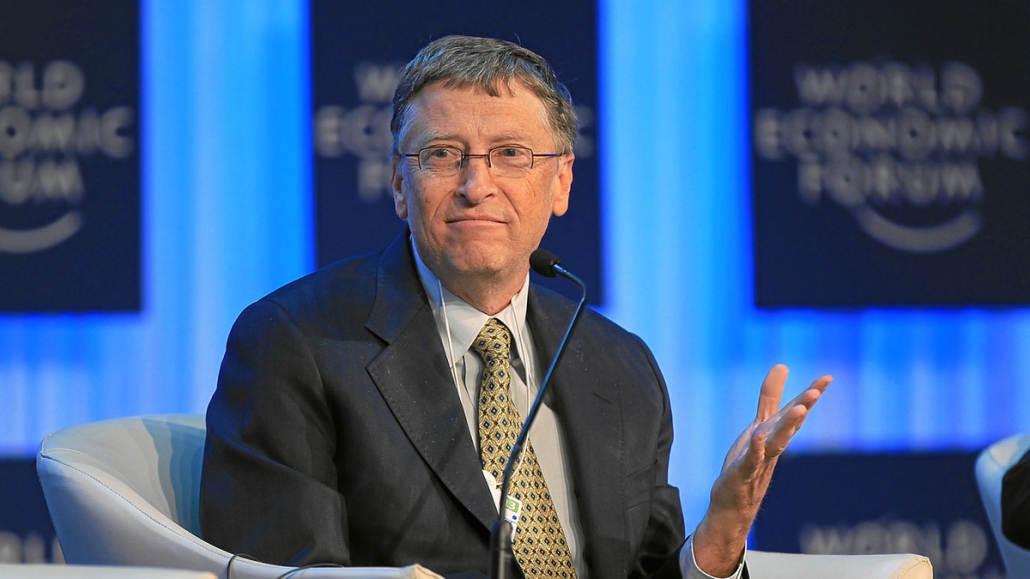
Photo: World Economic Forum via Flickr under CC 2.0 License.
 U.S. Government work