• Link to LinkedIn
  • Link to Facebook
  • Link to Instagram
  • Link to Youtube
  • Link to X
SUBSCRIBE TO NEWSLETTER
Joel Kotkin
  • About
    • Events
  • Media
    • In the News
    • Videos
  • Books
  • Articles
    • Demographics
    • Urban Affairs
    • The Economy
    • Politics
    • Rural Policy
    • Reports
    • Religion
    • California
  • Podcast
  • Speaking
  • Contact
  • Click to open the search input field Click to open the search input field Search
  • Menu Menu
You are here: Home1 / Articles2 / California

California’s Keenest Competitors for Tech Jobs are Blue Western States

December 28, 2021/in California, The Economy

For a generation, California has seen more of its residents and companies head elsewhere, but has found a way to respond, at least in terms of wealth creation, by constant innovation. But today, the Golden State’s hold on the elite reaches of the economy is slipping in ways that could threaten the state’s long-term prosperity.

Innovation is California’s best driver of high wages and upward mobility. Bureau of Labor Statistics data show that in the innovation industry — software, computer and semiconductor manufacturing, technology services and nine other sectors — the median wage was $208,000 in California last year. That’s almost three times the $76,000 median wage for all jobs in California.

But now, prime competition for innovation-based jobs comes not only from low-tax, low-cost states like Texas but also from bluish states such as Colorado and Washington. We found that Washington and Utah have actually created more innovation sector jobs per capita than California over the past decade, while Arizona, Colorado and Idaho have had higher per capita growth rates for such jobs.

Many of these states, noted Christopher Lloyd, chair of the Site Selection Guild, which follows investment flows, are duplicating “many of the great things about California.” This includes building elite university systems in places like Washington, Texas, Colorado and Utah. “The development model has turned on its head,” Lloyd suggests. “These states have learned from California. There seems to be a failure there to recognize things have changed and tech people are much more mobile.”

Keeping tech in California is all the more critical with the state suffering the nation’s highest unemployment rate and Los Angeles the highest of any large metro area. We have already experienced a troubling shift in business and professional service jobs such as accountants, lawyers and management consultants, the largest source of higher-wage jobs. Over the last three decades, Texas saw more than double the level of California’s growth in that sector, but Washington, Oregon and Colorado also outperformed California by a wide margin.

Now tech seems also under assault. Some tech linchpins have already moved their headquarters to Texas, including Hewlett Packard Enterprise, Oracle and, perhaps most crucial, Tesla. Many other firms, like Apple, Airbnb, Amgen, Uber and SpaceX, are expanding largely outside of this state. These trends are accelerating, notes a recent Hoover Institution study.

Of course, big companies often move production and jobs to cheaper locales. But growth in the number of innovation businesses is also slowing. Since 2005, the number of these businesses grew far faster on a per capita basis in Arizona, Utah, Colorado, Florida, Georgia and Oregon. This is not only a reflection of high taxes and regulation; many of our keenest competitors, such as Washington, Oregon and Colorado, are hardly governed by conservative, anti-regulatory politicians.

Read the rest of this piece at Los Angeles Times.


Joel Kotkin is the author of The Coming of Neo-Feudalism: A Warning to the Global Middle Class. He is the Roger Hobbs Presidential Fellow in Urban Futures at Chapman University and Executive Director for Urban Reform Institute. Learn more at joelkotkin.com and follow him on Twitter @joelkotkin.

Marshall Toplansky is a clinical assistant professor of management science at the Argyros School of Business and Economics at Chapman University.

Homepage photo: Alek Leckszas, via Wikimedia, CC 4.0 License.
https://joelkotkin.com/wp-content/uploads/2021/12/Los_Angeles_with_Mount_Baldy.jpg 675 1200 Joel Kotkin and Marshall Toplansky /wp-content/uploads/2017/01/jkotkin_logo.png Joel Kotkin and Marshall Toplansky2021-12-28 07:25:472021-12-26 17:32:21California’s Keenest Competitors for Tech Jobs are Blue Western States

California Dreamin’

November 13, 2021/in California, The Economy, Urban Affairs

“I just took [my son] to our local Walgreens to buy him a toy. While there, a man shoved past me so firmly that he sent me into the shelving. Then he proceeded to fill a brown paper bag with Halloween candy and waltzed out of the store. This is one of five Walgreens stores in SF that will be closing in the next two months, in part because of rampant theft. And our city leaders all keep insisting crime is down.”   San Fransicko: Why Progressives Ruin Cities, by Michael Schellenberger

Read more

https://joelkotkin.com/wp-content/uploads/2021/11/high-income-and-homeless-in-california-benjamin-disinger.jpg 675 1200 Joel Kotkin /wp-content/uploads/2017/01/jkotkin_logo.png Joel Kotkin2021-11-13 07:12:372021-11-12 09:28:55California Dreamin’

Slow Boat from China

October 29, 2021/in California, The Economy

To some in the Biden Administration, the supply chain crisis can be dismissed as a loss of East Asian-made consumer trinkets that, as Vox tells us, we could all be better off without—or as White House spokesperson Jen Psaki suggested, amounts to little more than “the tragedy of the delayed treadmill.” Yet, in reality, a broken supply chain is hardly a rich man’s problem—global bankers are having their best year ever—but mostly impacts ordinary folks suffering from rising prices for everything from soybeans to natural gas. The crisis is now expected to last for at least a year.

The chaos on the ground level may not much hurt the elites of Manhattan or Palo Alto, but inflation, which is now expected to continue apace for at least the next year, has wiped out wage gains in the U.S., the UK, and Germany. Low-income groups are the most threatened, struggling to pay energy costs, surging rents, and higher food prices. All this is also eroding President Biden’s already weak poll numbers.

Our vulnerability to supply chain disruption clearly predates the Biden Administration, forged by the abandonment of the production economy over the past 50 years by American business and government, encouraged and applauded by the clerisy of business consultants. The result has been massive trade deficits that now extend to high-tech products, and even components for military goods, many of which are now produced in China. When companies move production abroad, they often follow up by shifting research and development as well. All we are left with is advertising the products, and ringing up the sales, assuming they arrive.

Unable to stock shelves, procure parts, power your home, or even protect your own country without waiting for your ship to come in, Americans are now unusually vulnerable to shipping rates shooting up to ten times higher than before the pandemic. Not surprisingly, pessimism about America’s direction, after a brief improvement Biden’s election, has risen by 20 points. The shipping crisis is now projected to last through 2023.

Not everyone loses here. For years the American establishment saw China as more of an opportunity than a danger. High-tech firms, entertainment companies, and investment banks profit, or hope to, from our dependency, becoming in essence the new “China lobby.” Behind the scenes these representatives of enlightened capital often work to prevent condemnation for the Middle Kingdom’s mercantilist policy, and its joint repression of democracy and ethnic minorities.

After all, the pain is not felt in elite coastal enclaves, but in Youngstown, south Los Angeles, and myriad other decaying locales. Meanwhile, by enabling China’s focus on production, and the conquest of technologies related to making goods, we have devastated  large parts of our country.  This shift has cost us 3.7 million jobs since 2000. Throughout the period between 2004 and 2017, the U.S. share of world manufacturing shrank from 15 to 10 percent, while our reliance on Chinese inputs doubled, even as our dependence on Japan and Germany shrank.

Yet perhaps even more debilitating has been our drift towards what British historian Martin Weiner has called “psychological de-industrialization.” Weiner was referring to the lack of interest in productive enterprise during late Victorian and Edwardian England, but he could just as easily be describing contemporary America’s corporate and financial elite.

Fortunately, America is not England, now a shadow of itself as an industrial country, living off its imperial connections to bolster its media, finance, and tourism sectors. It is a small country, at the edge of a fading continent in seemingly permanent decline. It lacks our vast expanse with its agricultural, energy, and other resources, not to mention our still considerable entrepreneurial spirit. As a huge continental country with enormous resources, lots of arable land and a large, traditionally hard-working population, the United States should be ideally suited to survive the retreat of the global economy, so evident in the supply chain crisis, and be able to shift to a more autarchic model. 

Read the rest of this piece at American Mind.


Joel Kotkin is the author of The Coming of Neo-Feudalism: A Warning to the Global Middle Class. He is the Roger Hobbs Presidential Fellow in Urban Futures at Chapman University and Executive Director for Urban Reform Institute. Learn more at joelkotkin.com and follow him on Twitter @joelkotkin.

Homepage photo: Don Shall via Flickr under CC 2.0 License.

https://joelkotkin.com/wp-content/uploads/2021/10/slow-boat-from-china.jpg 675 1200 Joel Kotkin /wp-content/uploads/2017/01/jkotkin_logo.png Joel Kotkin2021-10-29 07:25:462021-10-28 18:21:48Slow Boat from China

Confronting the Supply Chain Crisis

October 16, 2021/in California, The Economy

For a generation, the Long Beach and Los Angeles harbors in California handled more than 40 percent of all container cargo headed into the US and epitomized the power of a globalizing economy. Today, the ships—mostly from Asia—still dock, but they must wait in a seemingly endless conga line of as many as 60 vessels, sometimes for as long as three weeks. These are the worst delays in modern history, and the price per container has risen to as much as 10 times its cost before the pandemic. The shipping crisis is now projected to last through 2023.

Read more

https://joelkotkin.com/wp-content/uploads/2021/10/backlog-of-cargo-at-port.jpg 675 1200 Joel Kotkin /wp-content/uploads/2017/01/jkotkin_logo.png Joel Kotkin2021-10-16 07:25:162021-10-13 13:10:38Confronting the Supply Chain Crisis

To Make Homeownership Affordable in California, Rethink the Suburbs

September 27, 2021/in California, Demographics

California’s future as a place of aspiration is fading for all but the wealthiest residents — with that promise nearly out of reach for young people and new immigrants.

This state has become a place marked both by spectacular successes and by not-so-welcome superlatives. The rise of the tech giants, engines of wealth creation, coexists with the nation’s highest cost-adjusted poverty rate, the second-lowest rate of homeownership among the states and the greatest concentration of overcrowded housing in the nation.

Read more

https://joelkotkin.com/wp-content/uploads/2021/09/new-home-construction.jpg 675 1200 Joel Kotkin /wp-content/uploads/2017/01/jkotkin_logo.png Joel Kotkin2021-09-27 07:25:562021-09-26 14:51:42To Make Homeownership Affordable in California, Rethink the Suburbs

Gavin Newsom Won His Recall. What’s Next for California?

September 16, 2021/in California, Politics, The Economy

What started as a lark, then became an impossible dream—a conservative resurgence, starting in California—ended, like many past efforts, in electoral defeat. With his overwhelming victory in the recall election, California governor Gavin Newsom and his backers have consolidated their hold on the state for the foreseeable future.

Read more

https://joelkotkin.com/wp-content/uploads/2021/09/gavin-newsom-wins-recall.jpg 675 1200 Joel Kotkin /wp-content/uploads/2017/01/jkotkin_logo.png Joel Kotkin2021-09-16 07:22:092021-09-15 15:38:23Gavin Newsom Won His Recall. What’s Next for California?

Progressives Have Ruined California

August 26, 2021/in California, Politics, The Economy

The very idea of a recall vote seemed absurd at first in California, this bluest of US states. Yet Californians’ surprisingly strong support for the removal of Democratic governor Gavin Newsom has resulted in precisely that, with the vote scheduled for 14 September. This reflects a stunning rejection of modern progressivism in a state thought to epitomise its promise.

Some, like the University of California’s Laura Tyson and former Newsom adviser Lenny Mendonca, may see California as creating ‘the way forward’ for a more enlightened ‘market capitalism’, but that reality is hard to see on the ground. Even before the pandemic, California already had the highest poverty rate and the widest gap between middle and upper-middle income earners of any state in the US. It now suffers from the second-highest unemployment rate in the US after Nevada.

Today, class drives Californian politics, and Newsom is peculiarly ill-suited to deal with it. He is financed by what the Los Angeles Times describes as ‘a coterie of San Francisco’s wealthiest families’. Newsom’s backers have aided his business ventures and helped him live in luxury – first in his native Marin, where he just sold his estate for over $6million, and now in Sacramento.

California’s well-connected rich are predictably rallying to Newsom’s side. At least 19 billionaires, mainly from the tech sector, have contributed to his extraordinarily well-funded recall campaign, which is outspending the opposition by roughly nine to one.

There is little hiding the elitism that Newsom epitomises. In the midst of a severe lockdown, he was caught violating his own pandemic orders at the ultra-expensive, ultra-chic French Laundry restaurant in Napa.

Newsom insists California is ‘doing pretty damn well’, citing record profits in Silicon Valley from both the major tech firms and a host of IPOs. He seems to be unaware that California’s middle- and working-class incomes have been heading downwards for a decade, while only the top five per cent of taxpayers have done well. As one progressive Democratic activist put it in Salon, the recall reflects a rebellion against ‘corporate-friendly elitism and tone-deaf egotism at the top of the California Democratic Party’.

Much of this can be traced back to regulatory policies tied to climate change (along with high taxes). These policies have driven out major companies – in energy, home construction, manufacturing and civil engineering – that traditionally employed middle-skilled workers. Instead, job growth has been concentrated in generally low-pay sectors, like hospitality. Over the past decade, 80 per cent of Californian jobs, notes one academic, have paid under the median wage. Half of these paid less than $40,000.

Read the rest of this piece at Spiked.


Joel Kotkin is the author of The Coming of Neo-Feudalism: A Warning to the Global Middle Class. He is the Presidential Fellow in Urban Futures at Chapman University and Executive Director for Urban Reform Institute. Learn more at joelkotkin.com and follow him on Twitter @joelkotkin.

https://joelkotkin.com/wp-content/uploads/2020/11/gavin-newsoms-posturing-ca-dismal-economics.jpg 675 1200 Joel Kotkin /wp-content/uploads/2017/01/jkotkin_logo.png Joel Kotkin2021-08-26 07:25:542021-08-31 17:31:43Progressives Have Ruined California

Why Did Larry Elder Call Me for Advice?

August 10, 2021/in California, Politics

The emergence of 69-year-old talk show host Larry Elder as the leading candidate to depose California’s Gavin Newsom is both odd and significant. Elder is no one’s idea of a politician, and when he called me for advice at the start of his run, I was perplexed. I thought Larry had it all — the nest egg, nice house, successful career.

Read more

https://joelkotkin.com/wp-content/uploads/2021/08/larry-elder-1024x576-1.jpg 576 1024 Joel Kotkin /wp-content/uploads/2017/01/jkotkin_logo.png Joel Kotkin2021-08-10 10:48:392021-08-10 10:48:39Why Did Larry Elder Call Me for Advice?

Garcetti’s Legacy

August 6, 2021/in California, Politics, The Economy, Urban Affairs

President Joe Biden has nominated Los Angeles mayor Eric Garcetti as ambassador to India. Assuming the Senate confirms him, Garcetti, who would leave office early (his second term ends in December 2022), might find India familiar in certain respects. Like Mumbai or Delhi, Los Angeles now has massive homeless encampments throughout the city, even increasingly in posh neighborhoods like Brentwood and throughout the middle-class strongholds of the San Fernando Valley. Late last week, as Garcetti prepared to leave town, homeless advocates, angered by a city ordinance against indiscriminate camping on city streets, vandalized Getty House, the mayor’s official residence.

Read more

https://joelkotkin.com/wp-content/uploads/2021/08/eric-garcetti.jpg 675 1200 Joel Kotkin /wp-content/uploads/2017/01/jkotkin_logo.png Joel Kotkin2021-08-06 07:25:272021-08-04 15:55:40Garcetti’s Legacy

California Fleeing

July 16, 2021/in California, Demographics, The Economy

Some longtime Californians view the continued net outmigration from their state as a worrisome sign, but most others in the Golden State’s media, academic, and political establishment dismiss this demographic decline as a “myth.” The Sacramento Bee suggests that it largely represents the “hate” felt toward the state by conservatives eager to undermine California’s progressive model. Local media and think tanks generally concede the migration losses but comfort themselves with the thought that California continues to attract top-tier talent and will remain an irrepressible superpower that boasts innovation, creativity, and massive capital accumulation.

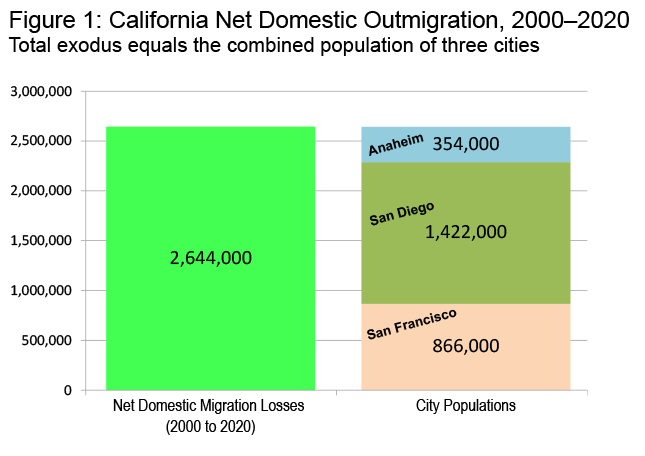
Reality reveals a different picture. California may be a great state in many ways, but it also is clearly breaking bad. Since 2000, 2.6 million net domestic migrants, a population larger than the cities of San Francisco, San Diego, and Anaheim combined, have moved from California to other parts of the United States. (See Figure 1.) California has lost more people in each of the last two decades than any state except New York—and they’re not just those struggling to compete in the high-tech “new economy.” During the 2010s, the state’s growth in college-educated residents 25 and over did not keep up with the national rate of increase, putting California a mere 34th on this measure, behind such key competitors as Florida and Texas. California’s demographic woes are real, and they pose long-term challenges that need to be confronted.

Source: Derived from U.S. Census Bureau Estimates

Source: Derived from U.S. Census Bureau Estimates

The state has suffered net outmigration in every year of the twenty-first century, but its smallest losses occurred in the early 2000s and the years following the Great Recession, when housing affordability was closer to the national average. Home prices have risen since then—and so have departures. Between 2014 and 2020, net domestic outmigration rose from 46,000 to 242,000, according to Census Bureau estimates.

The outmigration does not seem to have reached a peak. Roughly half of state residents, according to a 2019 UC Berkeley poll, have considered leaving. In Los Angeles, according to a USC survey, 10 percent plan to move out this year. The most recent Census Bureau estimates show that California started falling behind national population growth in 2016 and went negative for the first time in modern history last year.

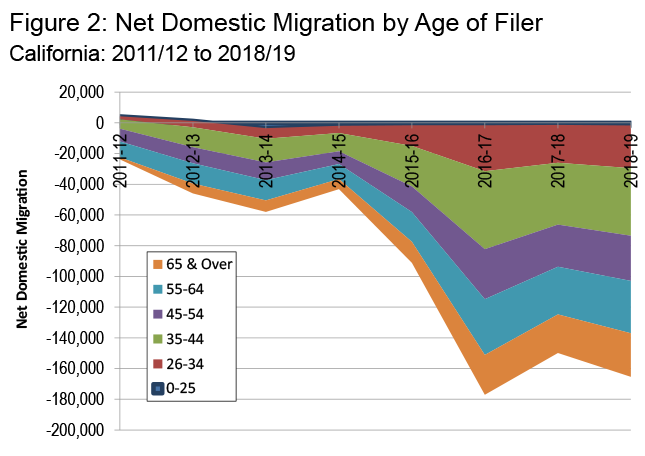
The comforting tale that only the old, bitter, and uneducated are moving out simply does not withstand scrutiny. An analysis of IRS data through 2019 confirms that increasing domestic migration is not dominated by the youngest or oldest households. Between 2012 and 2019, tax filers under 26 years old constituted only 4 percent of net domestic outmigrants. About 77 percent of the increase came among those in their prime earning years of 35 to 64. In 2019, 27 percent of net domestic migrants were aged 35 to 44, while 21 percent were aged 55 to 64. (See Figure 2.)

Source: IRS data

Source: IRS data

To be sure, the largest increase in net domestic migration was among those aged 65 and over. But the second-largest increase came in the 25 to 34 categories—with the state’s exorbitantly high cost of living the likely culprit.

Read the rest of this piece at City Journal.


Joel Kotkin is the author of The Coming of Neo-Feudalism: A Warning to the Global Middle Class. He is the Presidential Fellow in Urban Futures at Chapman University and Executive Director for Urban Reform Institute. Learn more at joelkotkin.com and follow him on Twitter @joelkotkin.

Wendell Cox is principal of Demographia, an international public policy firm located in the St. Louis metropolitan area. He is a founding senior fellow at the Urban Reform Institute, Houston, a Senior Fellow with the Frontier Centre for Public Policy in Winnipeg and a member of the Advisory Board of the Center for Demographics and Policy at Chapman University in Orange, California. He has served as a visiting professor at the Conservatoire National des Arts et Metiers in Paris. His principal interests are economics, poverty alleviation, demographics, urban policy and transport. He is co-author of the annual Demographia International Housing Affordability Survey and author of Demographia World Urban Areas.

Photo: Beatrice Murch, via Flickr under CC 2.0 License

https://joelkotkin.com/wp-content/uploads/2021/07/budget-moving-san-francisco.jpg 675 1200 Joel Kotkin and Wendell Cox /wp-content/uploads/2017/01/jkotkin_logo.png Joel Kotkin and Wendell Cox2021-07-16 07:25:032021-07-14 18:50:43California Fleeing
Page 13 of 36«‹1112131415›»
Search Search

Subscribe to Feed

Subscribe to RSS   follow us in feedly

Recent Articles

  • California is Aging Fast and Socialism Won’t Make Us Younger
  • How Socialism Captured the West Coast
  • Is Gavin Newsom’s White House Dream Fading?
  • AI and the Future of Work
  • Can Los Angeles Be Saved?

Joel has spoken at many leading universities, business groups, government organizations and more.

INVITE JOEL TO SPEAK

STAY CONNECTED

Join the conversation at Twitter
or Facebook. Visit our YouTube
channel or subscribe to RSS
to read our latest articles.

      Subscribe to RSS  follow us in feedly

Recent Articles

  • Demographics show that California's aging significantly
    California is Aging Fast and Socialism Won’t Make Us YoungerJuly 20, 2026 - 11:36 am
  • View across a bridge towards downtown San Francisco at night.
    How Socialism Captured the West CoastJuly 17, 2026 - 11:25 am
  • The field for California's next governor is uninspiring so far.
    Is Gavin Newsom’s White House Dream Fading?July 15, 2026 - 11:40 am
  • California now has blue state competition for tech jobs
    Can Los Angeles Be Saved?July 8, 2026 - 11:40 am

Topics

  • Books
  • California
  • Demographics
  • In the News
  • Podcast
  • Politics
  • Religion
  • Reports
  • Rural Policy
  • The Economy
  • Urban Affairs
© Copyright – Joel Kotkin | Site Admin
  • About
  • Media
  • Books
  • Articles
  • Podcast
  • Speaking
  • Contact
Scroll to top Scroll to top Scroll to top