
The Unexpected Future
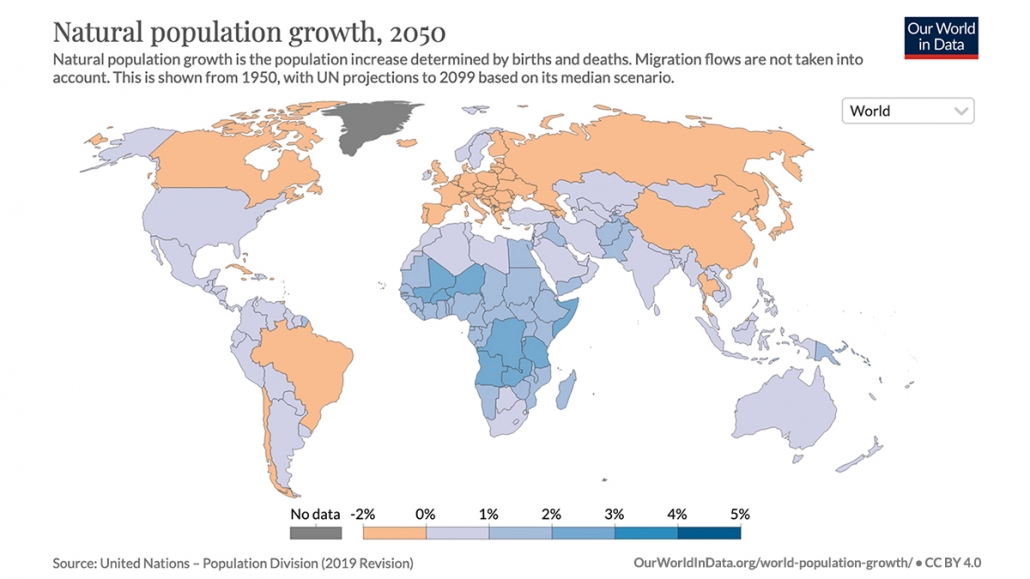
We are entering an unanticipated reality—an era of slow population growth and, increasingly, demographic decline that will shape our future in profound and unpredictable ways. Globally, last year’s total population growth was the smallest in a half-century, and by 2050, some 61 countries are expected to see population declines while the world’s population is due to peak sometime later this century.
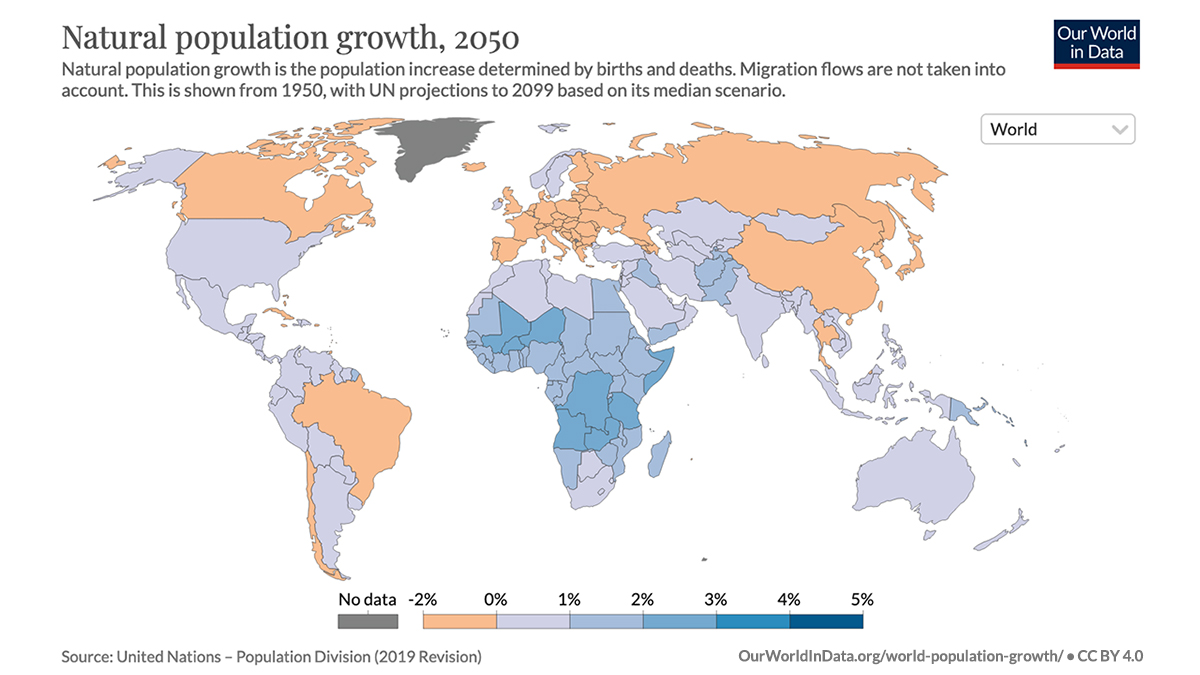
Chart credit: Our World In Data under CC 4.0 License.
This kind of long-term global demographic stagnation has not been seen since the Middle Ages. World population has been growing for centuries, but the last century has dwarfed previous rises. About 75 percent of the world’s population growth has occurred in the last hundred years, more than 50 percent since 1970. But now, population growth rates are dropping, especially in more developed nations, according to the United Nations (all subsequent references to UN research in this essay are drawn from these data).
It’s not a matter of if but when global populations will start to decline. Under the UN’s medium variant projection, the world’s population will peak in 2086, while under the low variant, the peak will occur in 2053, and by 2100, the population will be about a billion below today’s level. Demographer Wolfgang Lutz and colleagues project a global population of between 8.8 and 9.0 billion by 2050 falling to between 8.2 and 8.7 billion by 2100. The projected declines are concentrated in countries with high fertility rates, especially in sub-Saharan Africa. In the process, we will inhabit a rapidly aging planet. In 1970, the median world age was 21.5 years. By 2020, it had increased to 30.9 years, and the UN projects that it will be 41.9 years in 2100.
We are well past the time when we need to concern ourselves with Paul Ehrlich’s long-standing prophecy that humanity will “breed ourselves to extinction.” On the contrary, we need to worry about the potential ill-effects of depopulation, including a declining workforce, torpid economic growth, and brewing generational conflict between a generally prosperous older generation and their more hard-pressed successors. The preponderance of low fertility in wealthier countries also presages a growing conflict between the child-poor wealthy countries and the child-rich poor countries.
The shrinking of the rich world
Europe’s population shrank by 744,000 in 2020 and by 1.4 million last year—the largest fall on any continent since records began in 1950. Although worsened by the pandemic, this was largely an acceleration of a longstanding pattern. The EU’s population growth has been tapering for a generation, with fertility rates well below the 2.1 rate required to simply replace population The largest EU country, Germany, is forecast to drop five percent by 2050 while Italy is projected to lose 10 percent of its population. Overall, the 27-nation European Union projects that its population will drop from its 2022 figure of 447 million to 416 million by the century’s end.
European fertility has largely declined since the 1960s and the birth rate has slumped to “a 60-year low of 4 million births.” Compared to 1970, when 16.4 babies were born for every 1,000 persons, the crude birth rate dropped to 9.1 in 2020. Last year, the birth rate in England and Wales also hit a record low, with fertility rates for women under 30 at their lowest levels since records began in 1938. A fifth of all British women are childless by mid-life.
The lowest fertility rates are found in the countries of Eastern Europe, which have long been exporters of their shrinking youth populations. According to UN projections, Ukraine’s population will fall 18 percent from 2022 to 2050, even without accounting for the impact of the Russian invasion. Poland will be down 13 percent. Arch-rival Russia also faces inexorable depopulation: during 2019 (pre-pandemic), deaths were running about 50 percent higher than births there. With a 2022 population of 145 million, Russia is expected to drop to 133 million by 2050, according to the UN.
Plummeting fertility rates
Europe was the trailblazer of these new demographic trends but it is no longer an outlier. Over the past few decades, fertility has dropped precipitously in China, Taiwan, South Korea, Hong Kong, and Singapore. Today, all are saddled with birth rates well below replacement rates. South Korea’s birth rates have fallen for so long that the country plans to reduce its armed services to about half their current size within 20 years.
Read the rest of this piece at Quillette.
Joel Kotkin is the author of The Coming of Neo-Feudalism: A Warning to the Global Middle Class. He is the Roger Hobbs Presidential Fellow in Urban Futures at Chapman University and Executive Director for Urban Reform Institute. Learn more at joelkotkin.com and follow him on Twitter @joelkotkin.
Wendell Cox is principal of Demographia, an international public policy firm located in the St. Louis metropolitan area. He is a founding senior fellow at the Urban Reform Institute, Houston, a Senior Fellow with the Frontier Centre for Public Policy in Winnipeg and a member of the Advisory Board of the Center for Demographics and Policy at Chapman University in Orange, California. He has served as a visiting professor at the Conservatoire National des Arts et Metiers in Paris. His principal interests are economics, poverty alleviation, demographics, urban policy and transport. He is co-author of the annual Demographia International Housing Affordability Survey and author of Demographia World Urban Areas.












 Elvert Barnes, under CC 2.0 License