The Revenge of the Periphery
The 20th century was an era of consolidation and centralisation. Power shifted away from localities, communities and families, moving ever higher up the political food chain. In the ultimate shift, power flowed towards transnational bureaucracies – most notably in Europe, in the form of the EU.
Today, we may be seeing the emergence of a counter-trend: one that seeks to return control to local bodies, closer to where people actually live. The internet and social-media platforms, though destructive in many ways, have also empowered local communities, who now enjoy access to much the same information as those in Brussels or Washington, or in the corporate towers. Many communities, from small towns to exurbs, are benefiting from large-scale migration away from urban cores, as people escape the cities while bringing their skills and knowledge with them.
Centralisation emerged in eras when information was scarce and poorly distributed. The ideal of central control dovetailed with economic growth coordinated by concentrated power – whether in New Deal America or, more lethally, in Stalin’s USSR or Hitler’s Germany.
This ushered in an era of ever larger, denser cities that came to dominate economic and cultural life. Giant cities such as Berlin, New York, London, Paris and Tokyo departed from Aristotle’s model of cities as collections of ‘villages’. Instead, vast agglomerations emerged in which older ways of life were largely obliterated. Urbanity itself, noted the German sociologist Georg Simmel more than a century ago, created a ‘specialised individual’, deeply ‘dependent’ on the mechanisms of the city.
That pattern is now shifting. People in the United States are migrating out of big cities to exurbs and small towns. Much the same is occurring in Canada, where high housing prices are driving people – particularly millennials – towards ever more remote areas. In Australia, too, most domestic migrants have opted for the suburbs and, increasingly, for towns outside the once-favoured state capitals. There is even a shift back to the countryside in places such as France and Japan, where rural areas long assumed to be doomed are beginning to gain ground on their big-city counterparts.
Centrifugal forces are increasingly in command, as ever-improving communications reduce the necessity of locating in dense centres. Once, leaving the big city meant a downgrade in earnings. Today, all 10 of the highest-average-salary metropolitan areas in the US are small or mid-sized markets; none has more than a million people.
Read the rest of this piece at Spiked.
Joel Kotkin is the author of The Coming of Neo-Feudalism: A Warning to the Global Middle Class. He is the Roger Hobbs Presidential Fellow in Urban Futures at Chapman University and and directs the Center for Demographics and Policy there. He is Senior Research Fellow at the Civitas Institute at the University of Texas in Austin. Learn more at joelkotkin.com and follow him on Twitter @joelkotkin.
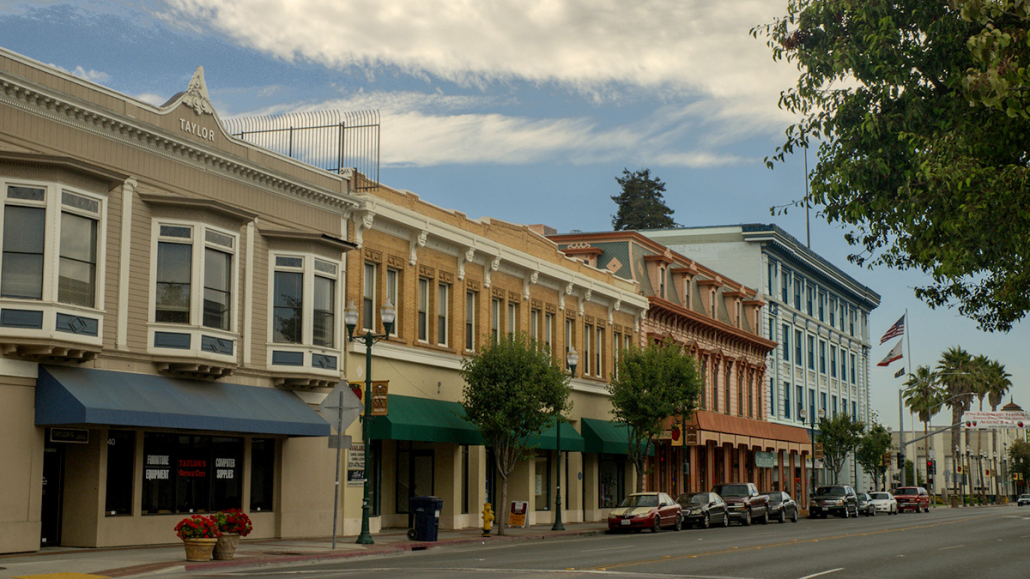
Photo: Watsonville — a medium sized agricultural city south of Santa Cruz in central California, via Flickr, under CC 2.0 License. Credit, Wayne Hsieh.