
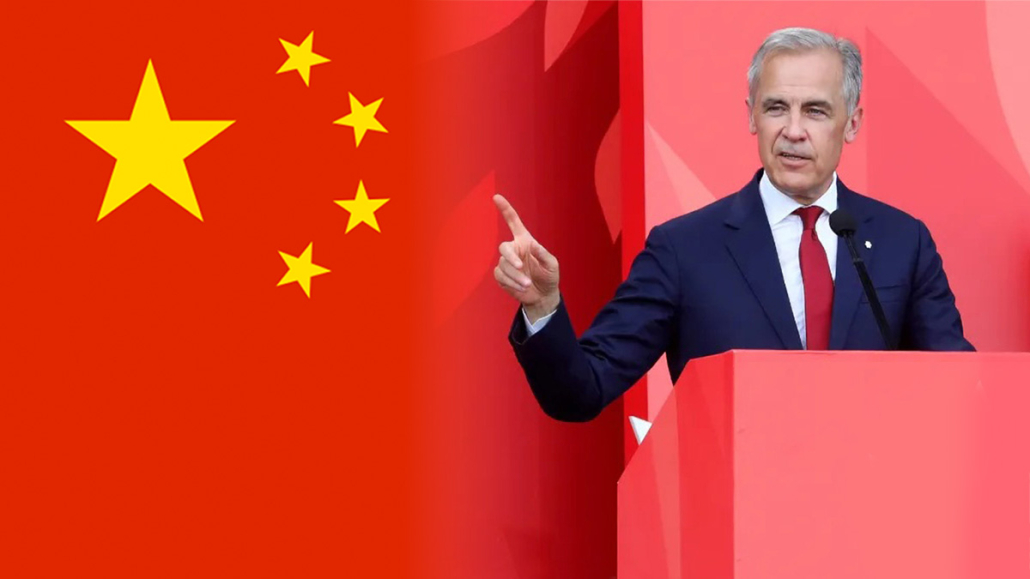
Carney is Turning Canada Into China’s Vassal State
The recent deal with China obliges Canada to send raw materials in exchange for manufactured goods, which is far less lucrative for Canada
Prime Minister Mark Carney’s speech at the recent Davos conference — where he called for decoupling from the U.S. while entering a “strategic partnership” with China — was greeted rapturously abroad. His tough on Trump rhetoric is certainly winning political points at home as well.
Yet, in listing towards China, Carney is not only ignoring geography, but embracing an authoritarian regime far more dangerous than anything coming from MAGA. China’s clear intention is to seek global hegemony based on trade with an array of vassal states. All are then expected to follow Beijing’s party line.
A Chinese-dominated Canada may be welcomed by some tired of U.S. power, but longer-term implications should give Canadians second thoughts. Unlike America, with its oscillating politics, China is a permanent one-party dictatorship. Its consistent policy is to win over countries with the raw materials that the country needs to feed its industrial machine. Once proud Russia is vassal number one, becoming ever more reliant on Chinese manufacturers and tech in exchange for access to its vast natural resources.
China does not really focus on the development of partners, as has occurred via western capital that drove the rise of Southeast Asia, and increasingly India. The shape of the Chinese neo-imperial system is most evident in Africa, with its wealth of resources and limited industry. As South African analyst Bheki Mahlobo has pointed out, China’s priority is to gain control of resource producers, often by keeping out American and other Western competitors. “China sees Africa as a critical element in their drive to reshape global power dynamics,” he writes.
China, he notes, “seems reluctant to share its industrial prowess.” After all, China’s entire economy relies largely on massive exports to pay for resources and build its military. Rather than build capacity to compete, China’s Belt and Road program, sold as developmental aid, often ends up in the role of a ruthless debt collector, seeking more concessions from countries that cannot pay up on time.
In Southeast Asia, China’s drive to control sea lanes including the seizure of islands in the South China Sea, threatens many countries, notably the Philippines and Vietnam. Some Asian countries — Cambodia, Laos, Mauritius — already function largely as vassal states, much as existed during the previous period of Chinese expansionism in the 15th century. In this era Chinese naval power was far greater than in still-backward Europe. Vietnam, Korea and Ceylon were among the nations that provided tribute while acknowledging the authority of the Emperor and the superiority of Chinese cultural values.
Today, Chinese apologists deny such a reversion to imperialism but this stands at odds with actual events. This trap Carney seems hell-bent on springing on Canada, although he has to consider retaliation from the U.S. which could devastate Canada’s economy. Where Canada generally enjoys a trade surplus with the U.S., in 2024, Canada exported $30 billion of products to China and imported nearly three times as much. Canada’s trade deficit with China has almost tripled, swelling from $22 billion in 2005 to $57 billion in 2024.
Read the rest of this opinion piece by Joel Kotkin, Special to National Post.
Joel Kotkin is the Roger Hobbs Presidential Fellow in Urban Futures at Chapman University and a senior Research Fellow at the Civitas Institute at the University of Texas at Austin. He writes a regular column for The National Post (Canada) and Spiked but contributes regularly to Unherd, LA Times, The Spectator, National Review, The Telegraph and City Journal. His last book was The Coming of Neo-Feudalism: A Warning to the Global Middle Class (Encounter: 2021). Also find Joel at joelkotkin.com, on Twitter @joelkotkin and Substack.







 Carol M. Highsmith, donated to the Library of Congress