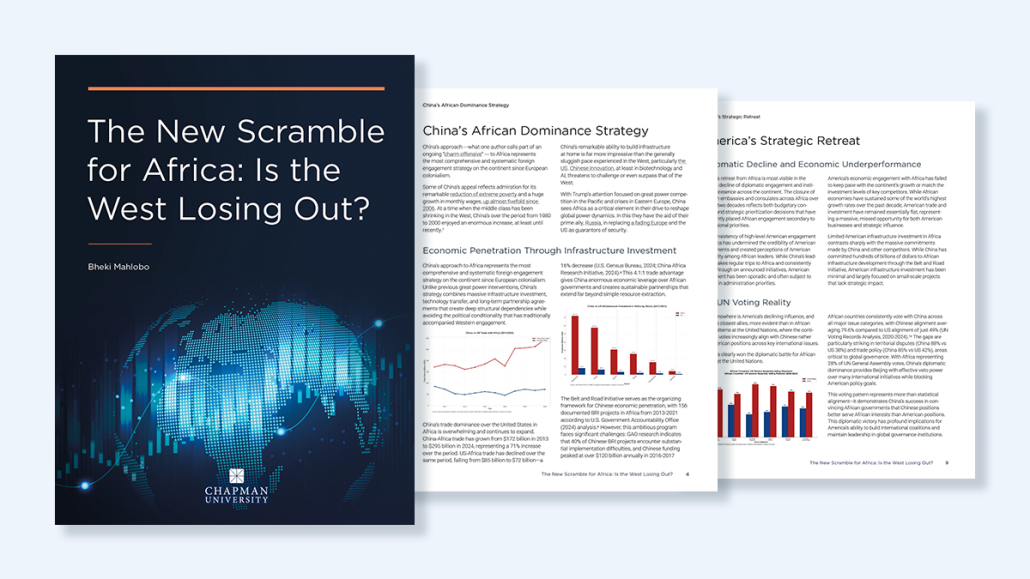
The New Scramble for Africa
This newly released report from The Center for Demographics and Policy at Chapman University is excerpted below, with a link to download the full report.
Executive Summary
America and the West overall face its most consequential strategic challenge in Africa since the end of the Cold War. While Washington’s attention has been focused on great power competition in the Pacific and crises in Eastern Europe, China has orchestrated a systematic campaign to dominate the African continent—alongside an opportunistic coalition of challengers including Russia, Iran, and Türkiye. This new scramble for Africa represents nothing less than a fundamental reshaping of global power dynamics, with stakes that extend far beyond the continent’s borders.
The numbers tell a stark story in particular of American decline and Chinese ascendancy. According to Nantulya (2025), Chinese firms are active stakeholders in 78 ports across 32 African countries as builders, financiers, or operators—representing over one-third of Africa’s 231 commercial ports. Turkey has achieved the most dramatic diplomatic expansion, growing from 12 to 44 embassies across the continent (+266%), while China expanded from 40 to 65 diplomatic missions (+63%) (Lowy Institute, 2024). Meanwhile, America’s diplomatic presence has declined slightly and trade volumes have contracted by 16% since 2013, while China’s trade with Africa has grown 71% to reach $295 billion in 2024 (U.S. Census Bureau, 2024; China Africa Research Initiative, 2024).
This retreat from Africa is not merely a regional setback; it represents an existential threat to American, and allied Western, global leadership. Africa sits at the nexus of three critical American interests: resource security for technological and defense industries, maritime control over global trade routes, and diplomatic leverage in international institutions. The continent’s transformation into a strategic battleground coincides with its emergence as home to five of the world’s ten fastest-growing economies and more cities over one million residents than Europe and America combined.
The stakes have never been higher. As Houthi attacks in the Red Sea disrupt traditional trade routes through the Suez Canal, alternative South Atlantic corridors through African partnerships become strategically essential. China’s systematic acquisition of African ports and naval facilities directly challenges America’s seven-decade role as guarantor of global maritime trade—the foundation upon which the post-war international order was built.
In this new model of the 19th Century’s “great game” between Russia and the British Empire, the real prize lies not in Europe or North America but emerging powers in Latin America but especially Africa, now home to five of the world’s ten fastest-growing economies —Ethiopia, Rwanda, Ghana, Ivory Coast, and Tanzania— sustaining GDP growth rates of 6% while the global average is expected to reach 3.1% in 2025 and 4.2% for emerging markets.
This far exceeds most developed economies, including China, as well as the neo-Stalinist brotherhood of Russia, China and North Korea. And unlike India or even Iran or Türkiye, Africa’s rise is just beginning. China’s strategy is clearly out-pacing both the US and now rapidly diminishing former European colonial powers who notes the EU’s foreign affairs and security policy chief Josep Borrell has warned, “little by little, we are losing Africa.”
Click here to download the full report.
About the author
Bheki Mahlobo is an economist and Partner at Frans Cronje Private Clients. He began his career at the Centre for Risk Analysis before joining the financial consulting firm ETM Analytics as a financial analyst. Specialising in economic and financial markets research as well as political trend analysis, Bheki has briefed numerous companies on South Africa’s long-term economic, market, and political outlook. He has drafted an extensive range of analytical notes and reports and he co-author of a chapter in the book The Future of Cities, written in collaboration with Professor Joel Kotkin of the American Enterprise Institute.
Raised in the rural Eastern Cape village of Lupapasi and later relocating to Johannesburg for his schooling, Bheki brings a unique perspective to his work. He is currently pursuing a Masters in Behavioural and Computational Economics at Chapman University, further enhancing his expertise in the field.
Joel Kotkin served as editor for this report. Joel is the Roger Hobbs Presidential Fellow in urban futures at Chapman University and a senior Research Fellow at the Civitas Institute at the University of Texas at Austin. He writes a regular column for The National Post (Canada) and Spiked but contributes regularly to Unherd, LA Times, The Spectator, National Review, The Telegraph and City Journal. His last book was The Coming of Neo-Feudalism: A Warning to the Global Middle Class (Encounter: 2021).