The Myth of Europe’s Fascist Revival
There’s a spectre haunting Europe – the spectre of fascism. Or at least that is what the Brussels establishment and its media allies seem to think. They never cease to liken the rise of national-populism to the movement that devastated the continent from the early 1920s until the end of the Second World War.
Yet is the right-wing, populist rebellion really a copy of 20th-century fascism? The Guardian, unsurprisingly, thinks so, raising the idea that Italian prime minister Giorgia Meloni, the one right-wing leader currently in office in a major country, represents a new version of Mussolini’s fascist movement. Much the same charge has been levelled at other Europeans labelled ‘far right’.
To be sure, many of the ascendant parties – the National Rally in France, Meloni’s Fratelli d’Italia, Germany’s AfD and even Nigel Farage’s Reform UK – have attracted some unpleasant figures, and even some genuine admirers of Mussolini. But are these parties and their supporters fascist in intent and tactics?
We certainly see nothing like the ecstatic crowds that came to hear Il Duce’s speeches. Right-wing protests do not generate anything like the enthusiasm that fascism inspired in Italian society, or later under Adolf Hitler in Germany.
Let’s look at Meloni, whose party has the closest historical ties to Mussolini’s movement. She hardly governs with dictatorial powers – she recently lost an important referendum on judicial reform and meekly accepted the result. She has also backed away from some of the promised crackdowns on immigration, largely at the behest of the business elite. ‘She has been about standing still’, suggests Mattia Guidi of the University of Siena. ‘She’s muddling through.’
When Meloni lost, no ‘blackshirts’ stormed the streets of Rome holding fasces or pictures of her. Likewise, when Viktor Orbán, often labelled a neo-fascist destroyer of democracy, lost this year’s Hungarian election, he simply yielded to the voters’ wishes and stepped down. He was then replaced by another rightist who promised to continue the country’s closed-door policy towards refugees and illegal migrants.
Yet the term ‘fascist’ does serve a purpose. It allows Europe’s elites, and their mimics in Britain, to deflect attention from the real cause of the rightward turn: their own failures.
In reality, the ‘far right’ of today does not resemble the fascists of the 1920s and 1930s. The son of a socialist blacksmith, Mussolini viewed himself as a revolutionary transforming society. Il Duce defined fascism as ‘organised, concentrated, authoritarian democracy’. His goal was to establish a ‘sublime totalitarian order’. During his heyday, he was widely admired in the West. The usually sober Times of London reported that under the fascists, ‘Italy has never been more united than she is today’, adding that the regime fostered a ‘spiritual revolution’.
The current far right lacks such a revolutionary vision. Italian fascism was profoundly future-oriented. Its ideological framework was captured well by leading Futurist Filippo Tommaso Marinetti, who embraced a vision that celebrated science, violence and a transhumanist ideal linked to technology. ‘War is beautiful’, he wrote, ‘because it initiates the dreamt-of metallisation of the human body’.
Fascism ‘drew in all class levels, from workers to the aristocracy’, notes Martina Caruso, whose great-uncle was persecuted by the regime, but who has been reading the letters of her grandfather, a particularly vicious fascist police commissioner. ‘It stirred people with a contemporary culture including the cult of beauty, the fetishisation of courage (and by extension violence), and the sense of belonging to a community. That’s how it gained hegemony – through symbols, mass rituals, the media and modernist architecture.’
Read the rest of this piece at Spiked.
Joel Kotkin is the author of The Coming of Neo-Feudalism: A Warning to the Global Middle Class. He is the Roger Hobbs Presidential Fellow in Urban Futures at Chapman University and and directs the Center for Demographics and Policy there. He is Senior Research Fellow at the Civitas Institute at the University of Texas in Austin. Learn more at joelkotkin.com, follow him on Substack and Twitter @joelkotkin.
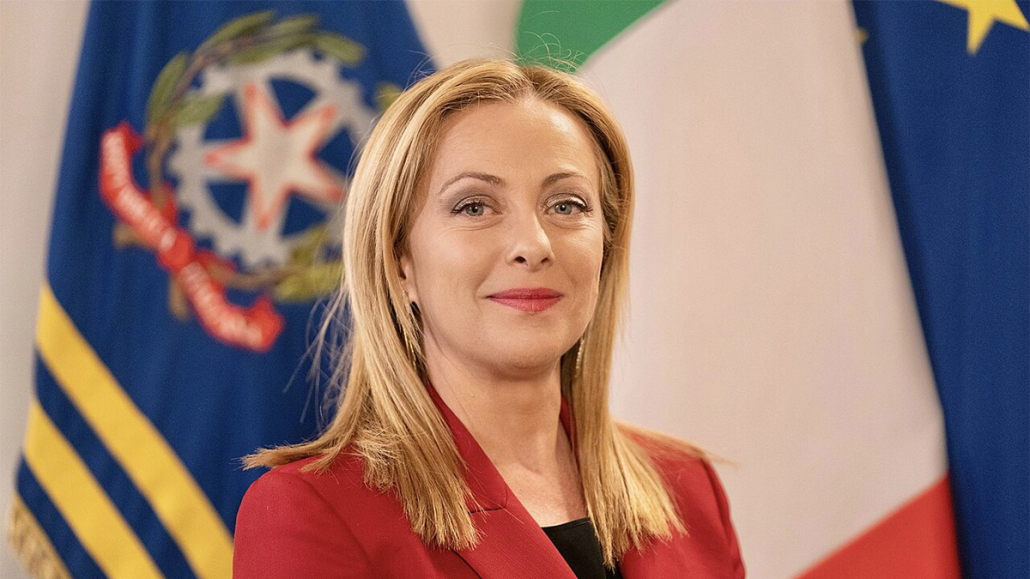
Homepage image: Official portrait of Giorgia Meloni Wikimedia under CC 3.0 License.