The American Revolution at 250
My closest comparison of the American Revolution at 250 years is from Roman republican history. So far, America today is still a republic in form, and the constraints of the constitution have not all been frittered away.
For all dark talk of fascism, the reality is that most anti-Trump people exercise their rights, there are no Blackshirts on the streets, except maybe Antifa. More to the point, MAGA is a divided movement led by a deluded old man, clearly becoming more deluded by the moment.
The declaration of independence was a classically liberal document, particularly if you were white, not a slave or indentured servant, or a woman. But that was the world in 1776.
Slavery was common at the time, not just in north America, but most prodigiously, in terms of numbers, in the Caribbean and south America. It was rampant in Africa itself, and particularly in the Ottoman Empire.
Given that reality, the declaration and the constitution were remarkable for the time, and certainly have relevance to this day. It was part of what R.R. Palmer called ‘the age of the democratic revolution,’ it inspired rebellions in France and eventually much of Europe and south America. All challenged centuries of royal, aristocratic and ecclesiastical domination.
This is still part of our legacy. But our revolutionary ideas naturally lost their hold as the former revolutionaries actually took power and had to deal with the realities of the world. Liberal ideals — what Jefferson called ‘an empire for liberty’ — clashed with being a nation-state facing off with larger, more despotic regimes.
That was not how it looked to Canadians as we twice sought to conquer them, or to the Mexicans who lost much of their country to America.
Maybe the wisest of presidents, Washington knew power challenged the republican ideal, much as in Rome. Ultimately the national interests of the republic, as opposed to a defense of classical liberalism, was what Washington meant when he urged us ‘to act for ourselves and not for others.”
Americans imperial phase, as William Appleman Williams noted, launched not just by a few, but by the demands of a nation of farmers looking for markets. Even then, the ideal did not die altogether die. The manifest destiny suggested in the 1840s by William Gilpin was seen as a way to “absolve the curse that weighs down humanity.”
The centrality of Washington rose with the civil war. As the bards and Karl Marx both noted, the conflict was not just a crusade against the evils of slavery, but also a struggle between an archaic, semi-feudal agrarian region and emerging industrial and agricultural capitalism.
The civil war, as justified as it was, changed the republic, by diminishing the power of communities and states, notably those in the south. Later a body of opinion emerged concerned about the increasingly imperial central state.
Much of this was based on southern racialism, but the point being made — emphasized more recently by the Pat Buchananite right — was that the republic was being altered by the expansion of the government and increasingly by our ventures abroad, which included the building of our own mini-me empire in Puerto Rico and the Philippines.
The ensuing conflicts of the two world wars, Korea, which ended up with a stalemate, and then somewhat botched interventions in Iraq and Afghanistan, gives some credence to the old rightists. More recently the Trumpian desire to please the rich gulf countries turned the Iran conflict into something that left the people of Iran hardly beneficiaries of Jefferson’s ‘empire for liberty.’
But much of our current democratic disorder grows from the gargantuan extent of the us itself, both in territory and population. As we know, Rome could not remain a republic when it ruled everything west of Mesopotamia and as much as one-fourth of the world’s population. Augustus, although he kept the trappings of the republic, founded a despotism which lasted for four centuries, and in the east, a whole millennium.
We show many signs, from both left and right, that threaten republican values of constraint and compromise. Democrats smashed the most basic constitutional principle by a regime of spying and censorship particularly under Biden administration. I saw this firsthand with my own podcast as we were censored by YouTube simply by interviewing a UC Irvine doctor skeptical about the COVID policy.
The approach of democrats, and even more so the progressives, seems to want to obliterate our constitutional state and turn it into something like a ‘people’s democracy,’ where the central power seeks to impose unanimity by design. The attack on the Supreme Court and the use of lawfare against the odious Trump hardly reflects constitutional propriety.
By 2020 Americans were fed up with Biden’s, or whoever was programming him, woke agenda and dismal economics. So we returned to office a man whose behavior on January 6, 2020 should have made him a pariah. In a sense Trump echoes Marius and Sulla, the military authoritarians, who together undermined the roman republic in its last decades.
Trump ended up benefiting from both Biden’s lawfare and the woke agenda — DEI, transgenderism, climate alarmism. He also managed to forge a temporary alliance with the tech oligarchs who had just before worked as Biden regime’s on-line enforcers.
Now as the Trump train derails, the new occupants of power seem eager to repeat his vengefulness and will to power. Senior Democrats like congressmen Robert Garcia, Hakeem Jeffries and Ted Lieu, reflecting the ugly illiberalism of our times, openly favor persecuting people and corporations aligned with Trump
They are cheered along by left-wing podcasters and even usually savvy people like James Carville have proposed that collaborators with Donald Trump’s administration should be publicly shamed, suggesting they have their heads “shaved, dressed in orange pajamas, and spat on”. This approach is not any better than Donald Trump’s revenge-seeking and corruption.
Let’s be clear our shift to an imperial presidency did not start with Trump. Our presidents increasingly behave like pharaohs. We have the awful examples Trump’s ballroom and Obama’s extra-ugly mausoleum. So much for republican virtue.
Today the executive operates largely as a somewhat constrained dictatorship. Institutions designed for a country of three million and thirteen colonies as opposed to a country of 330 million and 50 states seem overmatched.
To save the liberal republic, we need to look for ways to dial back the current centralization of power. One solution could be to revive the idea of ‘revenue sharing’, first proposed by President Richard Nixon, that sought to return federal dollars to localities, who could decide their own priorities.
The survival of the republican ideal necessitates handing more power to states and particularly localities. Both parties need to stop trying to enforce uniformity on a country that is far more diverse than in the 1770s. Outside of basic rights to every citizen — we can debate what they are — communities should be able to express their own preferences.
Centralization creates the ideal conditions for autocracy. It seeks to impose conformity, whether woke or Trumpian, against the wishes of the other half of the country. We need to curb the expansion of federal power. If Oregon, New York, or Los Angeles want to embrace socialism or transgenderism, that should be their right without asking Texas, Arizona, Florida, and the Carolinas to do the same.
This means reversing much of what has occurred in the last few decades. Obama with his ‘pen and phone’ response to Congress, his alliance with the oligarchs, later adopted by Biden, presages one way to construct 21st century imperium. So too does Trump’s peremptory steps to wage war and select who to prosecute. In both parties the alliance of lethal and legal power of the state with that of tech oligarchs — whose wealth exceeds that of most countries, augurs poorly for our republic.
All said, we should not give up the fight to preserve the revolution’s promise of self-governance and individual initiative. As R.R. Palmer put it: ‘the conditions are hard to meet, but the stakes are high, for the alternative may be worse.”
This article is a transcript from the first of Joel’s speaker panels at The American Revolution at 250, an event held in New York City on June 21, 2026, sponsored by Sublation Media.
Joel Kotkin is the author of The Coming of Neo-Feudalism: A Warning to the Global Middle Class. He is the Roger Hobbs Presidential Fellow in Urban Futures at Chapman University and and directs the Center for Demographics and Policy there. He is Senior Research Fellow at the Civitas Institute at the University of Texas in Austin. Learn more at joelkotkin.com, follow him on Substack and Twitter @joelkotkin.
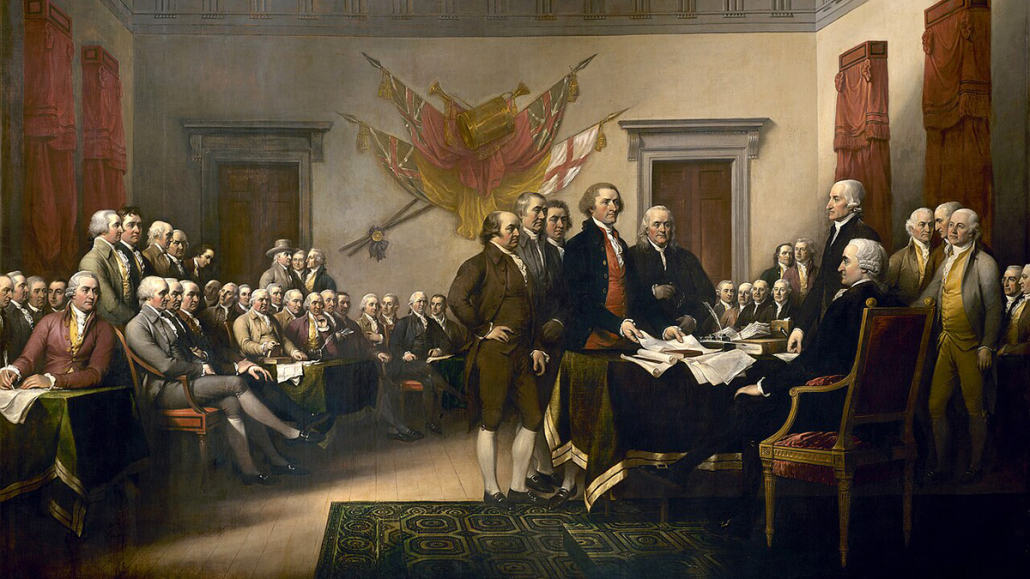
Photo: John Trumbull’s painting, Declaration of Independence, depicting the five-man drafting committee of the Declaration of Independence presenting their work to the Congress. Via Wikimedia, Public Domain.