Restoring the California Dream, Not Nailing Its Coffin
Virtually everyone, including Gov. Gavin Newsom, is aware of the severity of California’s housing crisis. The bad news is that most proposals floating in Sacramento are likely to do very little to address our housing shortage.
Newsom has promised to have 3.5 million homes built over the next seven years to solve the problem. That is, conservatively stated, more than 2.6 million that would be built at the current rate of construction.
This effort is doomed, though, since it fails to address the fundamental cause: regulations that block expansion of housing on the urban fringe, a housing area that serves to lower the price of both urban and suburban land. NIMBYs, who often block new projects, may contribute to the shortage, but by far the biggest problem lies in regulations, many issued from Sacramento, restricting lower-density housing construction on the urban fringe.
Former World Bank principal urban planner Alain Bertaud has pointed out that these regulations raise land prices and exacerbate housing shortages that particularly affect the poor. Before such policies were adopted, California’s housing prices relative to incomes were not far above the national average, even though the state’s population was expanding far more rapidly than today.
The subsidy trap
Newsom’s proposals include an estimated $1.75 billion to subsidize housing. But given the state’s median house price ($488,400), it would take $1.3 trillion to build an additional 2.6 million houses. If the state only built low-income housing, it would still cost $1.1 trillion. There is no official estimate on the number of units the governor’s $1.75 billion would build, but at California prices, spending all of it on construction would produce, at most, about 4,000 units, 1/600th what the governor’s program needs to produce.
Many groups — the homeless, the elderly, working families — have legitimate claim to state beneficence. But most Californians will end up paying for the bonds and taxes that will be required.
Others suggest more radical measures. Rent control lost last fall’s state-wide initiative, but many local initiatives may fare better. Some people suffering from rapidly inflated rents might benefit, but such controls would likely depress the production of housing in an already weaker market, particularly if imposed on newer buildings.
The density push
The other major initiative from Sacramento would involve stripping localities of zoning power to promote the development of high-density housing near transit stops. Last year a measure backing this approach by state Sen. Scott Wiener was defeated by virtually solid opposition from cities, including in progressive strongholds.
The assumption here is that such steps will improve affordability, though a recent MIT study found that up-zoning near transit in Chicago resulted in increased prices while not adding to the overall housing supply. Yet such is the messianic belief in density’s benefits that these ideas are being adopted as state policy, as evidenced by the governor’s recent assault on Huntington Beach’s housing policies .
Densification has strong backing from the green left, which often considers single-family housing as environmentally wasteful, racist, unaesthetic and anti-social. Victoria Fierce of the YIMBY pro-density lobby in California favors density in part because it promotes “collectivism” — reminiscent of the urban planning orthodoxy in the late, great Soviet Union.
Densification is also seen by some progressives as a way to assure a permanent majority, since apartments appeal largely to their base of mostly childless lifetime renters. After all, most apartments being built are either studios or one-bedroom units, so-called “vasectomy zoning” with ever-fewer family-friendly residences.
Ironically, the density push also wins the backing of some powerful libertarians who have bought into the concept of socially engineering people away from single-family dwellings into apartments. Progressive Bay Area writer Zelda Bronstein has detailed how densification has also been embraced by tech executives and speculators while being opposed by many advocates for “social equity, tenants’ rights and local control.”
What kind of state do you want?
California’s hard-pressed middle- and lower-income families have reason to be worried about this coalition between ultra-capitalist libertarians and the planning control freaks. Such an alliance has already succeeded in banning single-family zoning in Minneapolis, and seeks to do so in the entire state of Oregon.
The problem here: most people, particularly families, do not want to live in the dense, small apartments. As Mother Jones’ Kevin Drum points out: “The whole point of living in the suburbs is that it’s not the big city.” Socially engineering them into high density could lead to mass protests reminiscent of those by France’s “yellow jackets.”
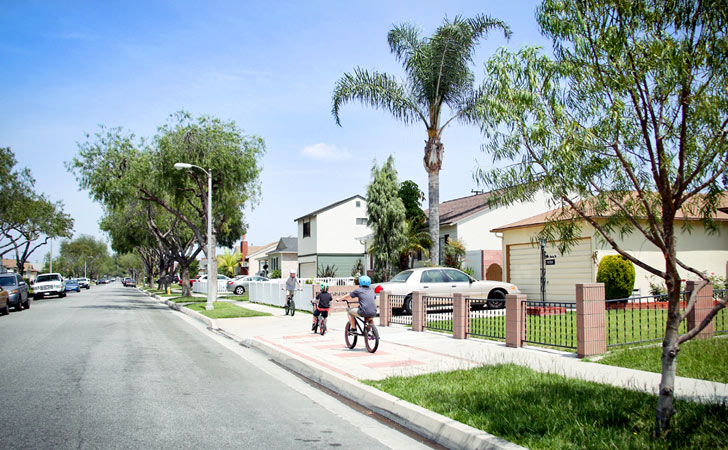
The solution, largely unthinkable among most urban theorists, is to allow new, more affordable suburban development. In the post-war era, California’s population was growing from three to six times as fast as now, but private enterprise, with government encouragement, met the challenge by building affordable housing in places such as Lakewood, Foster City, Valencia and Irvine. Newsom is right to invoke the need to restore the California Dream. But this can only be done with policies rooted not in ideology, but sound urban economics.
This article first appeared at The Orange County Register
Joel Kotkin is the Roger Hobbs Distinguished Fellow in Urban Studies at Chapman University and executive director of the Houston-based Center for Opportunity Urbanism. He authored The Human City: Urbanism for the rest of us, published in 2016 by Agate. He is also author of The New Class Conflict, The City: A Global History, and The Next Hundred Million: America in 2050. He is executive director of NewGeography.com and lives in Orange County, CA.
Wendell Cox is principal of Demographia, an international public policy and demographics firm. He is a Senior Fellow of the Center for Opportunity Urbanism (US), Senior Fellow for Housing Affordability and Municipal Policy for the Frontier Centre for Public Policy (Canada), and a member of the Board of Advisors of the Center for Demographics and Policy at Chapman University (California). He is co-author of the “Demographia International Housing Affordability Survey” and author of “Demographia World Urban Areas” and “War on the Dream: How Anti-Sprawl Policy Threatens the Quality of Life.” He was appointed to three terms on the Los Angeles County Transportation Commission, where he served with the leading city and county leadership as the only non-elected member. He served as a visiting professor at the Conservatoire National des Arts et Metiers, a national university in Paris.
Homepage photo credit: Lakewoodcity.org