Our Mad Aristos
In the past, ruling classes sought to protect the system that secured their coveted positions. But sometimes, as in the era before the French or Russian Revolutions, some in the ruling circles stopped believing in their religion, their traditions, and their state, only to be exiled, executed, or turned into what the Soviets called “former persons.”
Like our current elites, many French aristocrats lived dissolute lives but also supported revolutionary ideas which threatened “their own rights and even their existence,” as Alexis de Tocqueville noted. Today a large, even dominant portion of the wealthiest and most privileged parts of our society—including the heirs of nasty capitalist titans such as Henry Ford or John D. Rockefeller—are key funders of an increasingly anti-capitalist left. Others are still young tech billionaires and—increasingly—their discarded or former spouses.
This elite has arisen at a time when, as in France before 1789, inheritance is becoming ever more important as a vehicle for upward mobility, which is otherwise increasingly remote for most of the population. Home ownership among middle income Americans, for example, the primary means for asset accumulation for the non-rich, has dropped by over 8 percent in the past decade, while the wealthy have garnered the greatest gain from increased housing prices. American millennials are three times as likely as boomers to count on inheritance for their retirement. Among the youngest cohort, those ages 18 to 22, over 60 percent see inheritance as their primary source of sustenance as they age.
To be sure there will be a lot of wealth channeled to the offspring of the affluent. The consulting firm Accenture projects that the Silent Generation and baby boomers will gift their heirs up to $30 trillion by 2030, and up to $75 trillion by 2060. But this will benefit only a relatively small group, given the intense concentration of assets in ever fewer hands, with the top 1 percent in the U.S. increasing their share by roughly 50 percent since 2002. The class implications of this process are profound. There are over 70 million millennials in the U.S., and fewer than 1 percent of them are millionaires, while the median millennial household earns around $40,500, 20 percent less than boomers at the same stage of life.
The Great Disconnect
Given this vast wealth, we might expect a ruling class with a strong desire to protect capitalist accumulation. But instead, we have one that almost invariably, and perhaps suicidally, adopts progressive positions. Figuring out the psychological personal motivations of this impulse is way above my pay grade, but the economic underpinnings are fairly clear. The elites on Wall Street, and even more so in Silicon Valley, emerged from a highly competitive economy that impressed even leftists. At the Occupy Wall Street protests in 2011, anti-capitalist demonstrators held moments of silence and prayer for the memory of Steve Jobs, a particularly aggressive capitalist. One progressive writer, David Callahan, portrays the tech oligarchs, along with their allies in the financial sector, as a kind of “benign plutocracy” in contrast to those who built their fortunes on resource extraction, manufacturing, and material consumption.
Yet the tech elite today, as well as their Wall Street allies, no longer resemble the entrepreneurs of the past. The masters of our increasingly “woke” corporate elites are, for the most part, now second-generation bureaucrats presiding over the wealthiest, most pervasive monopolies on the plant. Controlling 90 percent of a market like search (Google), operating system software (Microsoft), dominating the cloud and on-line retail (Amazon) or 90 percent of phones (Google and Apple) does not turn executives into-risk takers but acquirers. Three tech firms now account as well for two-thirds of all on-line advertising revenues, which now represent the vast majority of all ad sales. Once paragons of entrepreneurial vigor, these firms, as Mike Lind has noted, have morphed into exemplars of “tollbooth capitalism,” which receive revenues on transactions that far exceed anything they lose in failed ventures and acquisitions.
Read the rest of this piece at American Mind.
Joel Kotkin is the author of The Coming of Neo-Feudalism: A Warning to the Global Middle Class. He is the Roger Hobbs Presidential Fellow in Urban Futures at Chapman University and Executive Director for Urban Reform Institute. Learn more at joelkotkin.com and follow him on Twitter @joelkotkin.
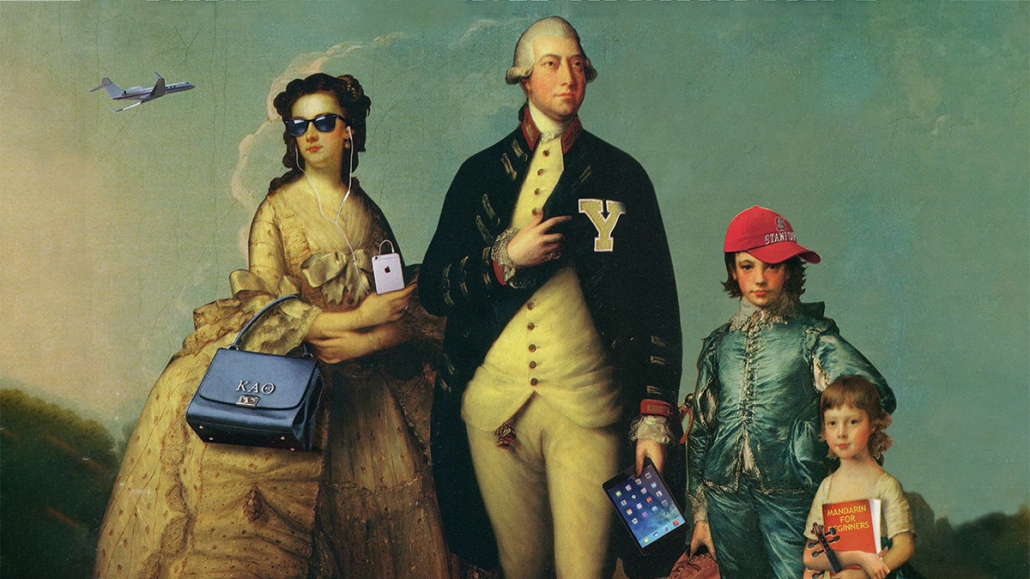
Photo: America’s New Aristocracy by Alan, via Flickr under CC 2.0 License.