• Link to LinkedIn
  • Link to Facebook
  • Link to Instagram
  • Link to Youtube
  • Link to X
SUBSCRIBE TO NEWSLETTER
Joel Kotkin
  • About
    • Events
  • Media
    • In the News
    • Videos
  • Books
  • Articles
    • Demographics
    • Urban Affairs
    • The Economy
    • Politics
    • Rural Policy
    • Reports
    • Religion
    • California
  • Podcast
  • Speaking
  • Contact
  • Click to open the search input field Click to open the search input field Search
  • Menu Menu
You are here: Home1 / Articles2 / Urban Affairs

Under Zohran Mamdani, the Jewish Exodus from New York Likely to Accelerate

July 9, 2025/in Politics, Urban Affairs

Zohran Mamdani may represent the future of New York, but only by destroying the secrets of its past success. The city, even under the quasi-socialist mayor Fiorello La Guardia, has from its Dutch days been a fundamentally capitalist enterprise. It is the search for success, often by less than respectable means, which led millions – including the ancestors of Donald Trump – to Gotham. Read more

https://joelkotkin.com/wp-content/uploads/2025/07/nyc-and-progressive-politics.jpg 675 1200 Joel Kotkin /wp-content/uploads/2017/01/jkotkin_logo.png Joel Kotkin2025-07-09 07:25:562025-07-08 10:53:45Under Zohran Mamdani, the Jewish Exodus from New York Likely to Accelerate

Homes for Hipsters

July 7, 2025/in Urban Affairs

More than his good looks, charm and great social-media game, the biggest reason that Zohran Mamdani may become New York’s next mayor grows from his focus on the city’s affordability crisis, most of which is tied to high housing prices.

Read more

https://joelkotkin.com/wp-content/uploads/2025/07/zohran-and-affordable-housing-crisis.jpg 675 1200 Joel Kotkin /wp-content/uploads/2017/01/jkotkin_logo.png Joel Kotkin2025-07-07 07:25:232025-07-06 18:16:26Homes for Hipsters

AI is Killing Jobs and Fueling Campus Radicalism

June 30, 2025/in Urban Affairs

Revolution and disruption rarely stem from the poor and destitute, but from what Alexis de Tocqueville described as “a revolution of rising expectations”. Read more

https://joelkotkin.com/wp-content/uploads/2025/06/ai-career-disruption-fueling-campus-radicalism.jpg 675 1200 Joel Kotkin /wp-content/uploads/2017/01/jkotkin_logo.png Joel Kotkin2025-06-30 07:25:382025-06-29 11:32:58AI is Killing Jobs and Fueling Campus Radicalism

Wars Are Won on the Factory Floor

June 26, 2025/in Urban Affairs

As recent events in Iran have so aptly demonstrated, technological progress married to industrial might produces the most tangible form of power. In the recent conflict in the Middle East, this meant that a second-tier power like Iran was clearly outmatched – first by Israel, then by America.

Read more

https://joelkotkin.com/wp-content/uploads/2025/06/mx-missile-assembly-factory.jpg 675 1200 Joel Kotkin /wp-content/uploads/2017/01/jkotkin_logo.png Joel Kotkin2025-06-26 07:10:202025-06-25 09:12:43Wars Are Won on the Factory Floor

How to Save Our Urban Centers

June 21, 2025/in Urban Affairs

“A great city is not to be confounded with a populous one.” — Aristotle

American cities face an existential choice. They can continue down their current path – adopting policies that work against the interests of local residents – or develop new approaches to make urban life work for the broad majority.

Today, many urban centers, particularly older cities, are in decline. The proportion of Americans living in core urban areas has been decreasing for generations, a trend that has only accelerated in the wake of the pandemic, rising crime, and increasingly radical politics.
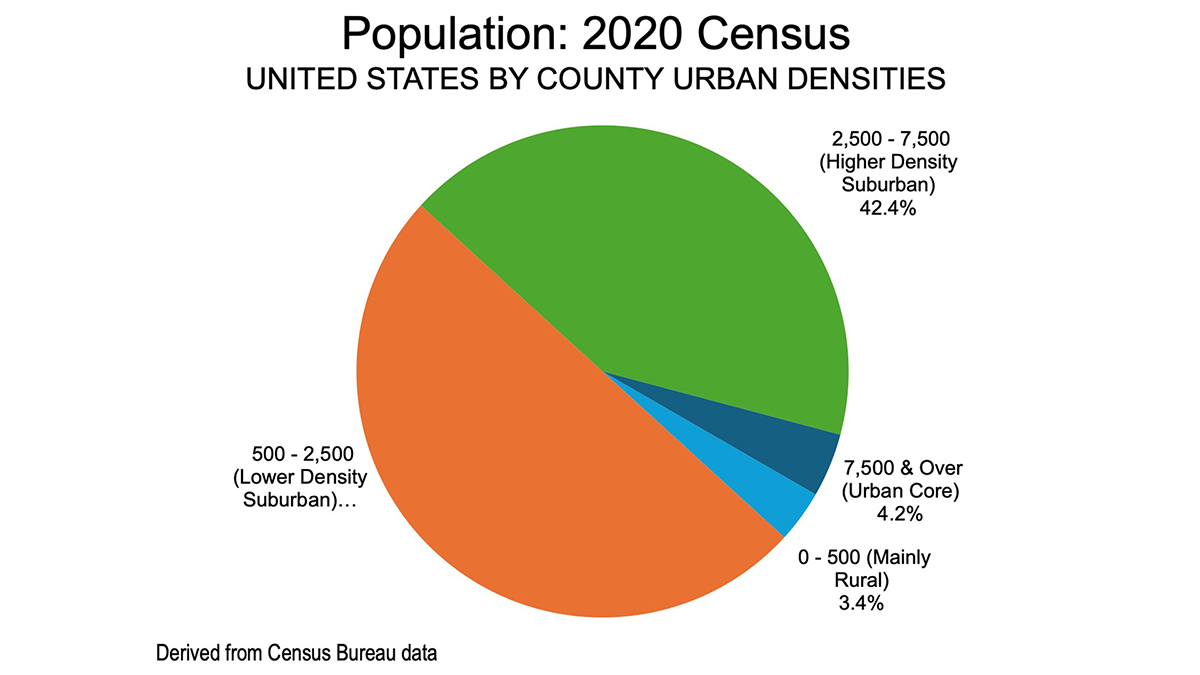
2020 Census: U.S. by county urban density

Economic and sociological trends are driving these changes. Even before the pandemic, the “transactional city” conceived by Jean Gottman – center of exchange, not production – was already facing challenges.1 Demographic and economic growth has shifted to less dense, often newer communities. The cities most identified with the transactional model – San Francisco, Chicago, and New York – are among those suffering the most.

Yet, urbanity itself – the concept of people living in proximity within a defined place – is far from dead. We continue to see the emergence of new communities on the urban periphery, as well as the revitalization of older suburban communities that are developing their own successful urban centers. In some major cities, even as office demand declines, residential construction continues to grow – particularly for the childless, young and affluent.

Rather than dismiss the urban future entirely, this paper explores how urbanism is being redefined in communities across the country. Cities, from the earliest times, have long been the cornerstones of human civilization. They will remain so – but in new and oft unrecognized forms, if local communities can organize themselves successfully.

View and download the full report here.


Joel Kotkin is the author of The Coming of Neo-Feudalism: A Warning to the Global Middle Class. He is the Roger Hobbs Presidential Fellow in Urban Futures at Chapman University and and directs the Center for Demographics and Policy there. He is Senior Research Fellow at the Civitas Institute at the University of Texas in Austin. Learn more at joelkotkin.com and follow him on Twitter @joelkotkin.


https://joelkotkin.com/wp-content/uploads/2025/06/2025-urban-centers-collage.jpg 675 1200 Joel Kotkin /wp-content/uploads/2017/01/jkotkin_logo.png Joel Kotkin2025-06-21 07:25:212026-02-03 17:41:35How to Save Our Urban Centers

Class Warfare LA Style

June 12, 2025/in California, The Economy, Urban Affairs

The most recent Los Angeles riots reflect, among other things, the response of immigrant activists to President Trump’s crackdown, and the latest resurgence of organized left-wing activism, which had been relatively quiet in the early months of the new administration. A less widely remarked factor, however, is the emerging and complex nature of class in contemporary America.

Read more

https://joelkotkin.com/wp-content/uploads/2025/06/Immigration-Rights_March_LA.jpg 675 1200 Joel Kotkin /wp-content/uploads/2017/01/jkotkin_logo.png Joel Kotkin2025-06-12 07:25:042025-06-11 11:31:17Class Warfare LA Style

LA Riots Reflect Failure of Progressive Leadership

June 10, 2025/in California, Demographics, Urban Affairs

Los Angeles has a long, combustible history — and it’s flaring up again. The current unrest, driven in part by political grievances, reflects a deeper dysfunction steadily eroding the city’s foundations. Read more

https://joelkotkin.com/wp-content/uploads/2025/06/protests-IceOutOfLA.jpg 675 1200 Joel Kotkin /wp-content/uploads/2017/01/jkotkin_logo.png Joel Kotkin2025-06-10 07:25:582025-06-08 16:19:57LA Riots Reflect Failure of Progressive Leadership

Where Have All the Jews Gone?

June 3, 2025/in Urban Affairs

The killing of two young Israeli embassy staffers, allegedly by a college-educated, left-wing activist earlier this month, provided yet more evidence – if any were needed – of the perilous situation in which Western Jews now find themselves. Read more

https://joelkotkin.com/wp-content/uploads/2025/06/killing-of-two-israeli-embassy-emplyees.jpg 675 1200 Joel Kotkin /wp-content/uploads/2017/01/jkotkin_logo.png Joel Kotkin2025-06-03 07:25:342025-06-02 15:42:06Where Have All the Jews Gone?

Building the Future: Fixing the Global Housing Crisis

June 1, 2025/in The Economy, Urban Affairs

This is the second of a two-part series on the global housing crisis. Read the first part here.

The affordable housing crisis in America and many other advanced countries keeps getting worse because it is largely dominated by the wrong voices talking about the wrong places.

Read more

https://joelkotkin.com/wp-content/uploads/2025/05/exurban-development-affordable-housing.jpg 675 1200 Joel Kotkin and Wendell Cox /wp-content/uploads/2017/01/jkotkin_logo.png Joel Kotkin and Wendell Cox2025-06-01 07:21:152025-05-30 08:22:17Building the Future: Fixing the Global Housing Crisis

Locked Out of the Dream: Regulation Making Homes Unaffordable Around the World

May 31, 2025/in The Economy, Urban Affairs

Next to inflation, Americans ranked housing as their top financial worry in a Gallup survey last May. It’s only gotten worse. January home sales were down 5% from last year’s dismal numbers. Record numbers of first-time buyers are stuck on the sidelines as housing affordability stands at the lowest level ever recorded, while one in three Americans now spend over 30% of their income on mortgage or rent.

The housing crisis is not just an American problem, but a global phenomenon that hits the middle and working classes the hardest. Studies of the Canadian, British, European, and East Asian markets have also found that housing prices have risen far faster than household incomes and inflation. A report from the Organisation for Economic Co-operation and Development concluded that “housing has been the main driver of rising middle-class expenditure.” In prosperous and communitarian Switzerland, Zurich studios sell for well over $1 million, and small houses even more, making downpayments unaffordable to affluent people despite the overwhelming financial advantages to homeowners.

Underlying the plight of home buyers worldwide is a sometimes overlooked but profound influence – the spread of restrictive land-use regulations. It’s reshaping political and economic alignments in ways that may further destabilize the social order. Home ownership is strongly correlated with positive social indicators, and as renting grows twice as quickly as buying, this trend poses a threat to Western democracy by deepening economic inequality, depressing demographic vitality, and undermining the upward mobility that has driven Western progress for the past century.

Cost of Over-Regulation

The price increase may seem surprising because there has not been a huge spike in fundamental demand. In California, and most of the United States, as well as Europe and East Asia, population growth is tepid, if not declining. Today’s higher interest rates are below those that prevailed from 1970 to 1995, when housing costs were considerably lower relative to incomes. Nor is this predominantly a technical problem; the rise of remote work, which is connected to migration to smaller metros, as well as new technologies for building, including using 3D printers, actually offers the chance to build more cheaply.

And yet, the principal cause for housing shortages and rising prices stems from the failure to build enough new housing units, particularly the single-family homes consumers most desire. Homebuilders built 1 million fewer homes (including rental units) in 2024 than in 1972, when there were 130 million fewer Americans. One estimate puts the U.S. housing market shortage at an estimated 4.5 million homes, according to Commerce Department data.

The rapid inflation of housing costs stems primarily from ever more constricting land-use regulations. Inflated prices are particularly rife in countries and states with strict regulations like California, where high-income households now utterly dominate the housing market, and more than a third of all real estate transactions in recent years topped $1 million.

Read the rest of this piece at: Real Clear Investigations.


Joel Kotkin is the author of The Coming of Neo-Feudalism: A Warning to the Global Middle Class. He is the Roger Hobbs Presidential Fellow in Urban Futures at Chapman University and and directs the Center for Demographics and Policy there. He is Senior Research Fellow at the Civitas Institute at the University of Texas in Austin. Learn more at joelkotkin.com and follow him on Twitter @joelkotkin.

Wendell Cox is principal of Demographia, an international public policy firm located in the St. Louis metropolitan area. He is a Senior Fellow with Unleash Prosperity in Washington and the Frontier Centre for Public Policy in Winnipeg and a member of the Advisory Board of the Center for Demographics and Policy at Chapman University in Orange, California. He has served as a visiting professor at the Conservatoire National des Arts et Metiers in Paris. His principal interests are economics, poverty alleviation, demographics, urban policy and transport. He is author of the annual Demographia International Housing Affordability Survey and author of Demographia World Urban Areas.

Homepage photo: Travis Saylor via Pexels.

https://joelkotkin.com/wp-content/uploads/2025/05/locked-out-of-housing-market.jpg 675 1200 Joel Kotkin and Wendell Cox /wp-content/uploads/2017/01/jkotkin_logo.png Joel Kotkin and Wendell Cox2025-05-31 07:16:372025-05-30 08:23:03Locked Out of the Dream: Regulation Making Homes Unaffordable Around the World
Page 5 of 50«‹34567›»
Search Search

Subscribe to Feed

Subscribe to RSS   follow us in feedly

Recent Articles

  • Zohran Mamdani’s Socialist New York Dream is About to Turn Sour
  • Why Latinos Are California’s Best Hope for a Sane Housing Market
  • Retiring the Nutty Professor
  • The American Revolution at 250: a Legacy to Fulfill
  • The American Revolution at 250

Joel has spoken at many leading universities, business groups, government organizations and more.

INVITE JOEL TO SPEAK

STAY CONNECTED

Join the conversation at Twitter
or Facebook. Visit our YouTube
channel or subscribe to RSS
to read our latest articles.

      Subscribe to RSS  follow us in feedly

Recent Articles

  • New Yorkers celebrate the passage of a bill to freeze rents.
    Zohran Mamdani’s Socialist New York Dream is About to Turn SourJuly 1, 2026 - 11:45 am
  • Exurban and inland California communities are the most affordable of the state's housing markets.
    Why Latinos Are California’s Best Hope for a Sane Housing MarketJune 29, 2026 - 11:45 am
  • Publicity photo for 1963 movie, The Nutty ProfessorPublic Domain
    Retiring the Nutty ProfessorJune 26, 2026 - 11:35 am
  • The American Revolution left us a legacy to fulfill.
    The American Revolution at 250: a Legacy to FulfillJune 24, 2026 - 11:35 am

Topics

  • Books
  • California
  • Demographics
  • In the News
  • Podcast
  • Politics
  • Religion
  • Reports
  • Rural Policy
  • The Economy
  • Urban Affairs
© Copyright – Joel Kotkin | Site Admin
  • About
  • Media
  • Books
  • Articles
  • Podcast
  • Speaking
  • Contact
Scroll to top Scroll to top Scroll to top