The Ghost of Ancient Rome Haunts America
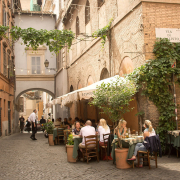
The death of Ancient Rome wasn’t so much a collapse as a slow, interminable decay: between the second and sixth centuries AD, its population declined from a million people to just 30,000. Since then, 15 centuries have passed and thousands of cities have been built. And yet, as Rome’s greatest chronicler Edward Gibbon warned in 1776, a similar fate awaits our modern metropolises. This time, however, their decline will radically alter our perception of what “urbanism” really means.
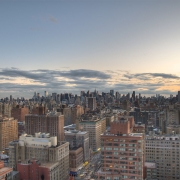
London, New York, San Francisco, Chicago, Los Angeles — these urban centres epitomised what Jean Gottman described in 1983 as “transactional cities”. Based on finance, high-end business and IT services, they were defined not by production and trade in physical goods, but by intangible products concocted in soaring office towers. For years, academic researchers, both on the Left and Right, envisioned a high-tech economic future dominated by dense urban areas. As The New York Times‘s Neil Irwin observed in 2018: “We’re living in a world where a small number of superstar companies choose to locate in a handful of superstar cities where they have the best chance of recruiting superstar employees.”
Yet even before the current downturn, the data defied the bravado. For decades, the ultra-tall towers that once symbolised urban greatness have been as anachronistic as the cathedrals of the Middle Ages. Office occupancy has been declining since the turn of the century, along with the construction of new space. In 2019, before the pandemic, construction was one-third the rate of 1985 and half that of 2000.
More serious still has been the movement of people. Migration to dense cities started to decline in 2015, when large metropolitan areas began to see an exodus to smaller locales. By 2022, rural areas were also gaining population at the expense of cities. The pandemic clearly accelerated this process, with a devastating rise in crime and lawlessness: notably in London, Paris, Washington, New York, Los Angeles, San Francisco, Philadelphia and Chicago. In some parts of Chicago and Philadelphia, young men now have a greater chance of being killed by firearms than an American soldier serving during the Afghanistan or Iraq wars.
The fading allure of the big city — further undermined by the post-pandemic shift to remote work in many sectors — is also taking place against the backdrop of an urban economy that has increasingly rewarded the few. Of course, some districts, such as the north side of Chicago, have experienced impressive growth, but they are often surrounded by others suffering from severe deterioration. And for all of gentrification’s wonders, almost a fifth of residents in the 50 largest US cities live below the poverty line.
Contrast this with the historic role of cities as engines of upward mobility. Even the addition last year of a few thousand migrants forced New York Mayor Eric Adams to declare a state of emergency; in other words, New York, a city largely built on the labour of newcomers, now seems too weak to house and employ a substantial number of immigrants. Amid this failure, perhaps it’s unsurprising that migrants and minorities are heading to America’s suburbs, sprawled sunbelt cities and smaller towns.
So what is the urban future? The answer lies less in the central business districts than the suburbs and exurbs. And this presents a nightmare for the traditional urbanist. In contrast to central business districts, suburban offices have fared far better while sprawled areas such as Tampa, Fort Lauderdale, Austin and Nashville have become the nation’s hottest office markets. With the large majority of major metropolitan area residents already outside the urban cores, the most enticing economic opportunities may lie in modern-day versions of Ebenezer Howard’s “garden cities”, such as Cinco Ranch outside Houston or New Albany near Columbus.
Read the rest of this piece at UnHerd.
Joel Kotkin is the author of The Coming of Neo-Feudalism: A Warning to the Global Middle Class. He is the Roger Hobbs Presidential Fellow in Urban Futures at Chapman University and Executive Director for Urban Reform Institute. Learn more at joelkotkin.com and follow him on Twitter @joelkotkin.
Homepage photo: Kelly via Pexels.