• Link to LinkedIn
  • Link to Facebook
  • Link to Instagram
  • Link to Youtube
  • Link to X
SUBSCRIBE TO NEWSLETTER
Joel Kotkin
  • About
    • Events
  • Media
    • In the News
    • Videos
  • Books
  • Articles
    • Demographics
    • Urban Affairs
    • The Economy
    • Politics
    • Rural Policy
    • Reports
    • Religion
    • California
  • Podcast
  • Speaking
  • Contact
  • Click to open the search input field Click to open the search input field Search
  • Menu Menu
You are here: Home1 / Articles2 / The Economy

A New Dawn for the Working Class?

February 9, 2022/in Politics, The Economy

The labouring masses are restless, as evidenced by the Canadian trucker strike, union drives in Amazon warehouses in the US and in demonstrations throughout the developing world. More revealing still may be the turmoil in the labour markets, where workers are changing jobs, creating their own and, overall, refusing to return to the structures of the pre-pandemic order.

Read more

https://joelkotkin.com/wp-content/uploads/2022/02/canada-truckers-working-class-protest.jpg 675 1200 Joel Kotkin /wp-content/uploads/2017/01/jkotkin_logo.png Joel Kotkin2022-02-09 07:25:152022-02-17 08:59:01A New Dawn for the Working Class?

How Biden Can Defeat China

January 27, 2022/in Politics, The Economy

In 1930, John Dos Passos wrote that America is many things: it is a “slice of a continent”, “the world’s greatest river valley”, and “a set of bigmouthed officials with too many bank accounts”. “But mostly,” he wrote in The 42nd Parallel, America “is the speech of the people”.

Read more

https://joelkotkin.com/wp-content/uploads/2022/01/joe-biden-speaking_by-gage-skidmore.jpg 675 1200 Joel Kotkin /wp-content/uploads/2017/01/jkotkin_logo.png Joel Kotkin2022-01-27 07:22:012022-02-17 08:59:22How Biden Can Defeat China

California’s Economy is Weaker Than it Looks

January 19, 2022/in California, The Economy

Whisper it, but the $45 billion surplus Gavin Newsom has projected for California next year isn’t quite what it seems. In fact, the bulk of that surplus is largely due to the earnings of a few giants such as Google, Apple and Meta (formerly Facebook), as well as a handful of IPOs. Read more

https://joelkotkin.com/wp-content/uploads/2022/01/newsom_2019-conference_by-gage-skidmore.jpg 675 1200 Joel Kotkin /wp-content/uploads/2017/01/jkotkin_logo.png Joel Kotkin2022-01-19 07:25:462022-02-17 09:00:22California’s Economy is Weaker Than it Looks

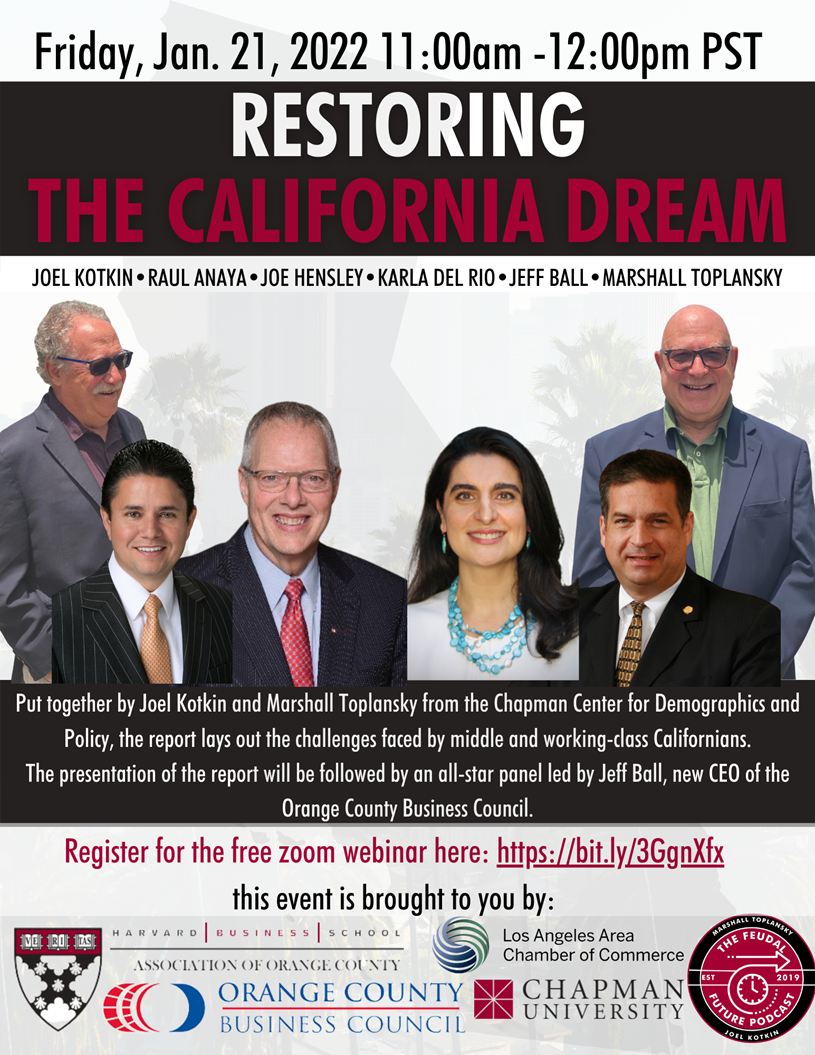
Restoring the California Dream

January 18, 2022/in California, The Economy

Join us for a webinar hosted by Joel Kotkin and Marshall Toplansky to learn how we can restore the California Dream for middle and working class Californians. Following the presentation of the report, there will be an all-star panel led by Jeff Ball, new CEO of the Orange County Business Council.

Panel participants include Raul Anaya, Joe Hensley, and Karla Del Rio.

Register for the free Zoom webinar Restoring the American Dream

Restoring California Dream

Related:

Click here to view or download a copy of the full report (17MB PDF opens in new tab or window)

https://joelkotkin.com/wp-content/uploads/2022/01/webinar-restoring-ca-dream.jpg 800 990 Joel Kotkin and Marshall Toplansky /wp-content/uploads/2017/01/jkotkin_logo.png Joel Kotkin and Marshall Toplansky2022-01-18 16:17:512022-02-17 09:00:06Restoring the California Dream

California is a Bastion of Innovation Marred by Deep Inequality. Is That America’s Future?

January 17, 2022/in California, The Economy, Urban Affairs

Everyone seems to be California dreaming these days. Much of America, particularly its red parts, see California as a hopeless dystopia best understood as everything the nation should avoid. Meanwhile, for the progressive Left and many around Joe Biden, California is the Mecca, a great role model being attacked by jealous reactionaries.

As in so many cases, both sides have a piece of the truth.

Read more

https://joelkotkin.com/wp-content/uploads/2022/01/homeless-silicon-valley.jpg 600 800 Joel Kotkin /wp-content/uploads/2017/01/jkotkin_logo.png Joel Kotkin2022-01-17 07:25:102022-02-17 09:00:52California is a Bastion of Innovation Marred by Deep Inequality. Is That America’s Future?

Class War is Just Beginning

January 12, 2022/in The Economy

With the seeming deconstruction of the Biden Administration proceeding at a rapid clip, many on the right hope for an end to the conscious stoking of class resentments that has characterized progressive politics. Yet despite the political meltdown, America’s class divides have become so wide, and so bitter, that Biden’s presidency may prove more a prelude than a denouement for the future of class warfare.

Read more

https://joelkotkin.com/wp-content/uploads/2022/01/shopping_cart_abandoned.jpg 675 1200 Joel Kotkin /wp-content/uploads/2017/01/jkotkin_logo.png Joel Kotkin2022-01-12 07:23:342022-01-10 08:41:13Class War is Just Beginning

California’s Keenest Competitors for Tech Jobs are Blue Western States

December 28, 2021/in California, The Economy

For a generation, California has seen more of its residents and companies head elsewhere, but has found a way to respond, at least in terms of wealth creation, by constant innovation. But today, the Golden State’s hold on the elite reaches of the economy is slipping in ways that could threaten the state’s long-term prosperity.

Innovation is California’s best driver of high wages and upward mobility. Bureau of Labor Statistics data show that in the innovation industry — software, computer and semiconductor manufacturing, technology services and nine other sectors — the median wage was $208,000 in California last year. That’s almost three times the $76,000 median wage for all jobs in California.

But now, prime competition for innovation-based jobs comes not only from low-tax, low-cost states like Texas but also from bluish states such as Colorado and Washington. We found that Washington and Utah have actually created more innovation sector jobs per capita than California over the past decade, while Arizona, Colorado and Idaho have had higher per capita growth rates for such jobs.

Many of these states, noted Christopher Lloyd, chair of the Site Selection Guild, which follows investment flows, are duplicating “many of the great things about California.” This includes building elite university systems in places like Washington, Texas, Colorado and Utah. “The development model has turned on its head,” Lloyd suggests. “These states have learned from California. There seems to be a failure there to recognize things have changed and tech people are much more mobile.”

Keeping tech in California is all the more critical with the state suffering the nation’s highest unemployment rate and Los Angeles the highest of any large metro area. We have already experienced a troubling shift in business and professional service jobs such as accountants, lawyers and management consultants, the largest source of higher-wage jobs. Over the last three decades, Texas saw more than double the level of California’s growth in that sector, but Washington, Oregon and Colorado also outperformed California by a wide margin.

Now tech seems also under assault. Some tech linchpins have already moved their headquarters to Texas, including Hewlett Packard Enterprise, Oracle and, perhaps most crucial, Tesla. Many other firms, like Apple, Airbnb, Amgen, Uber and SpaceX, are expanding largely outside of this state. These trends are accelerating, notes a recent Hoover Institution study.

Of course, big companies often move production and jobs to cheaper locales. But growth in the number of innovation businesses is also slowing. Since 2005, the number of these businesses grew far faster on a per capita basis in Arizona, Utah, Colorado, Florida, Georgia and Oregon. This is not only a reflection of high taxes and regulation; many of our keenest competitors, such as Washington, Oregon and Colorado, are hardly governed by conservative, anti-regulatory politicians.

Read the rest of this piece at Los Angeles Times.


Joel Kotkin is the author of The Coming of Neo-Feudalism: A Warning to the Global Middle Class. He is the Roger Hobbs Presidential Fellow in Urban Futures at Chapman University and Executive Director for Urban Reform Institute. Learn more at joelkotkin.com and follow him on Twitter @joelkotkin.

Marshall Toplansky is a clinical assistant professor of management science at the Argyros School of Business and Economics at Chapman University.

Homepage photo: Alek Leckszas, via Wikimedia, CC 4.0 License.

https://joelkotkin.com/wp-content/uploads/2021/12/Los_Angeles_with_Mount_Baldy.jpg 675 1200 Joel Kotkin and Marshall Toplansky /wp-content/uploads/2017/01/jkotkin_logo.png Joel Kotkin and Marshall Toplansky2021-12-28 07:25:472021-12-26 17:32:21California’s Keenest Competitors for Tech Jobs are Blue Western States

Western Greed Fuels China’s Domination

December 20, 2021/in Politics, The Economy

There is a hypocrisy at the heart of the West’s attitude to China: although we’re constantly warned about the threat from Beijing, our political and corporate elites seem intent on making this century a Chinese one. Unlike in the Thirties, this appeasement isn’t driven by fear and ignorance; it is motivated largely by greed.

And that greed could prove fatal. China’s “civilisation state”, deeply rooted in thousands of years of history, represents the most profound philosophical challenge to liberal values since the end of the Cold War. But our oligarchs choose to ignore this, preferring instead to genuflect to Beijing for financial gain.

Read more

https://joelkotkin.com/wp-content/uploads/2021/12/Xi-Jinping-and-Joe-Biden.jpg 675 1200 Joel Kotkin /wp-content/uploads/2017/01/jkotkin_logo.png Joel Kotkin2021-12-20 07:10:282021-12-17 17:13:21Western Greed Fuels China’s Domination

The New Dark Ages

December 15, 2021/in Demographics, The Economy, Urban Affairs

If ignorance is bliss, the Western world should be ecstatic. Even as colleges churn out degrees and collect fees, and technology makes information instantly accessible, the basic level of literacy, as measured by such things as reading books and acquainting oneself with the past, is in a precipitous decline. Rather than building a vital world with our technological culture, we are repeating the memes of feudal times, driven by illiteracy, bias and a rejection of the West’s past.

Read more

https://joelkotkin.com/wp-content/uploads/2021/12/new-dark-ages-decline-of-literacy.jpg 675 1200 Joel Kotkin /wp-content/uploads/2017/01/jkotkin_logo.png Joel Kotkin2021-12-15 07:25:422021-12-14 17:30:56The New Dark Ages

Our Neo-Feudal Future

December 13, 2021/in Politics, The Economy

America has only a limited feudal past, the plantation aristocracy of the antebellum South and the enormous class chasms of the Gilded Age being pretty much our only examples. Yet today—after decades of social mobility, a digital revolution that was supposed to empower individuals everywhere, and the construction of a vigorous anti-discrimination apparatus that putatively ensures equal rights and status—a rigid new social order with feudal elements has come into view.

This emerging class structure reprises, albeit with far less ­starvation, the patterns of the Middle Ages, with each class performing distinct social functions and defined economic roles. In this new order, there are two ­ascendant classes: the oligarchs and the clerisy. And there are two classes struggling to serve the ­ascendant classes, and to maintain for ­themselves a decent standard of living: the ­yeomanry and the new serfs.

The old feudal order evolved gradually, as the last structures of Roman republicanism first weakened, then totally collapsed due to the barbarian invasions. The seizure of Europe by the barbarian hordes upended an entire ­civilization, including its class structures. The collapse was due as much to the weakness of Roman institutions as to the ruthlessness of barbarian leaders. The feudalism that ensued would simplify ­society under the rule of two ­classes, the military aristocracy and the ­clerical class, while most people lived ­essentially in bondage to one or the other.

This historical precedent can help us make sense of the socioeconomic trends of America’s last half-century. Since the 1970s, the wealth differential between middle-­income and upper-income households in the United States has grown. Data from the Census Bureau show that the share of national income going to the middle 60 percent of households has fallen to a record low. Wealth gains in recent decades have been made overwhelmingly by the top 1 percent of households, ­especially the top 0.5 percent. In 1945–73, the top 1 percent in America captured just 4.9 percent of total U.S. income growth; in the following two decades, this super-rich cohort gobbled up the majority of it. The combined wealth of the ­richest four hundred Americans now exceeds the total wealth of 185 ­million of their fellow citizens. Over the past three decades, the share of household wealth owned by the top 0.1 percent has increased from 7 percent to 22 percent.

This pattern has been ­accelerated by the pandemic. The number of millionaires around the world jumped to 56.1 million in 2021, with 5.2 million joining the group last year, according to the 2021 Credit Suisse Global Wealth Report. The number of ultra-high net worth individuals—those with a net worth above $50 million—grew by 24 percent, to 215,030. Last year, Amazon tripled its profits and Jeff Bezos made $70 billion; billionaires overall have earned more than $1 trillion since March. Alphabet, Amazon, Apple, Facebook, and Microsoft now make up 20 percent of the American stock market’s total value. As one Silicon Valley wag put it, America increasingly resembles “feudalism with better marketing.”

The similarities are not just material. In the Middle Ages, the aristocracy shared common views. Kings and chieftains fought over land and gold, but rarely (until the Reformation) ideas and truths. The ideals of a pluralistic society wouldn’t have meant anything to them, nor would John Stuart Mill’s marketplace of ideas. Now, after two centuries of an Enlightenment-influenced public square hot with dissent and debate, we observe the emergence of a singular mindset among the academy and the media—today’s clerisy—and the oligarchic elite. In the past, political views, religious beliefs, and special interests divided the elite and forced different factions to persuade and cajole and convince the masses of their respective ­sanctions. Every major city had multiple newspapers with distinct lines on current events, serving as organs for rival powers. Pro-slavery versus anti-­slavery, labor versus management, Wall Street versus the farmers, interventionists versus isolationists: It’s a history of ­ideological conflict.

No such broad conflict exists among today’s nobility. They are unified in their progressive outlook on all things social and cultural. In the Middle Ages, the aristocracy often found allies among the Catholic clergy, who were willing to back the great landowners’ laws and swords with doctrines and rationales. There is a twenty-first-­century clerisy, though it is rarely religious and operates in a secular consumer society. Its members aren’t priests. They are journalists, entertainers, credentialed professionals, and teachers. They provide the images, narratives, arguments, and artworks that reinforce the binding outlook, and they police dissenters as vigilantly as did the Inquisitors of old (though fortunately, so far, less ­lethally).

As society becomes more regulated and more dependent on expertise, the clerisy grows. Michael Lind estimates that this “overclass” constitutes some 15 percent of the American workforce, a far larger portion than the membership of the old First Estate (closer to 1 percent of the French population). Charles Murray describes them more narrowly as the top echelons in law, government, university, and ­media—roughly 2.4 million people in a country of more than 320 million.

Until the last four decades, the yeoman class—James Madison’s small proprietors—were America’s ascendant socioeconomic group. A study covering the United Kingdom, the Netherlands, and the United States shows that all three saw a rapid decline in the concentration of wealth from the 1820s through the 1970s. Never before had so much prosperity and relative security been so widely enjoyed.

Now, the numbers and influence of the yeomanry are declining. They still represent close to 50 percent of the population, notes Pew—a drop from 61 percent in 1971. Globalization has savaged many middle-class jobs, whether in factories or in services, transferring employment to China, India, and other developing countries. In many countries, immigration, much of it from poor countries, has undermined wage rates, particularly for lower-skilled workers, but now for professionals as well. Much of the global middle class is heavily in debt, mainly because of high housing costs.

In the United States, long known as the land of opportunity, the chance of middle-class earners’ moving to the top rungs of the earnings ladder has dropped by approximately 20 percent since the early 1980s. The pandemic has been particularly hard on this class. Though large chains have reported record sales during the lockdowns, more than 160,000 small ­businesses have closed. A survey by the advocacy group Main Street America predicts that as many as 7.5 million small businesses will go out of business by the time the crisis is over. By some estimates, upwards of one-third of small businesses will close down permanently.

The fall of the yeomanry poses a major threat to representative democracy. Once again, history provides a precedent. In Imperial Rome, small farmers and artisans were steadily displaced by slaves imported from the far ends of the expanding empire. Increasingly, occupations and social status came to be determined by heredity. By the end of the Republic, more than 75 percent of all property was owned by roughly 3 percent of the population, while more than four-fifths owned no property at all. Inequality paved the way for the feudal future.

The great social achievement of the mid- to late twentieth century lay in the movement of working-class, propertyless people, including minorities, into the ranks of business owners and homeowners. Today the flow runs in the opposite direction, as prospects for joining the middle class have declined and opportunities for advancement have dried up for everyone outside the professional and elite capitalist classes.

Working-class people, of whatever race, suffer the worst health-­related impacts and have paid the most in lives during the pandemic. The same holds economically. In the U.S., roughly half of all job ­losses last April were in such low-paying fields as restaurants, hotels, and amusement parks; information and finance jobs were barely touched. Almost 40 percent of Americans making less than $40,000 a year lost their jobs in the pandemic, as the wage gains made during the first two years of the Trump Administration have largely evaporated.

Read the rest of this piece at First Things.


Joel Kotkin is the author of The Coming of Neo-Feudalism: A Warning to the Global Middle Class. He is the Roger Hobbs Presidential Fellow in Urban Futures at Chapman University and Executive Director for Urban Reform Institute. Learn more at joelkotkin.com and follow him on Twitter @joelkotkin.

Homepage photo: ILO Asia-Pacific Flickr under CC 3.0 License.

https://joelkotkin.com/wp-content/uploads/2021/12/electronics-factory-workers.jpg 675 1200 Joel Kotkin /wp-content/uploads/2017/01/jkotkin_logo.png Joel Kotkin2021-12-13 07:03:022021-12-12 13:12:22Our Neo-Feudal Future
Page 16 of 66«‹1415161718›»
Search Search

Subscribe to Feed

Subscribe to RSS   follow us in feedly

Recent Articles

  • I’d Like to Believe California Can Be Saved from the Left
  • The Strange Afterlife of Fascism
  • Steve Hilton’s Rise Won’t Kill California Progressivism
  • The Anti-AI Backlash is Building Against Tech Oligarchs Playing God
  • SpaceX IPO Will Bolster American Tech Supremacy

Joel has spoken at many leading universities, business groups, government organizations and more.

INVITE JOEL TO SPEAK

STAY CONNECTED

Join the conversation at Twitter
or Facebook. Visit our YouTube
channel or subscribe to RSS
to read our latest articles.

      Subscribe to RSS  follow us in feedly

Recent Articles

  • California has been a one-party state for awhile; can that change?
    I’d Like to Believe California Can Be Saved from the LeftJune 8, 2026 - 11:45 am
  • The Strange Afterlife of FascismJune 5, 2026 - 11:40 am
  • Steve Hilton speaking at an event for conservative officials
    Steve Hilton’s Rise Won’t Kill California ProgressivismJune 3, 2026 - 11:40 am
  • The Anti-AI Backlash is Building Against Tech Oligarchs Playing GodJune 1, 2026 - 11:40 am

Topics

  • Books
  • California
  • Demographics
  • In the News
  • Podcast
  • Politics
  • Religion
  • Reports
  • Rural Policy
  • The Economy
  • Urban Affairs
© Copyright – Joel Kotkin | Site Admin
  • About
  • Media
  • Books
  • Articles
  • Podcast
  • Speaking
  • Contact
Scroll to top Scroll to top Scroll to top