Media Meltdowns and Political Polarization
The mainstream media increasingly appears much like the classic tale of the boy who cried wolf so often that when the wolf showed up no one believed him.
Similarly, since the bust of the Mueller report, and the evaporation of countless other “blockbuster” exposés, the media’s credibility in the ongoing impeachment saga is now widely doubted, even if this time they may actually be right about presidential misdeeds.
This divide can be seen in public perceptions of the news media. Although somewhat improved from its low point in 2016, only 40 percent of Americans, according to Gallup, trust the media, compared to over 50 percent in 1999. As befits the media’s increasingly partisan stance, the small improvement over 2016 comes almost entirely from Democrats. Only 15% of Republicans and barely a third of independents now trust media compared to nearly 70% of Democrats.
Once the news business had enough sense of propriety and professionalism to at least maintain an appearance of objectivity. There’s ample reason, as Glenn Reynolds suggests, to see many mainstream journalists as little more than “Democrats with bylines,” willing participants in what long-time leftist and fiercely anti-Trump reporter Matt Taibbi describes as the upper bureaucracy’s “permanent coup” against Trump. If this “coup” now actually succeeds, it will be one that will simply accentuate hostility to the media among a large segment of the population.
Media faces an economic crisis
No president has suffered such total opposition from powerful media. In his first year in office, stories about Trump were 62 percent negative, notes Pew, almost three the rate for Obama and more than twice that for George W. Bush, certainly no media favorite. His positive coverage was barely 5 percent, one eighth that enjoyed by President Obama. Some have thrived from naked partisanship, including an increasingly aggressive series of pro-Trump outlets. The New York Times, de facto leader of the anti-Trump media lynch mob, has seen its subscriptions burgeon, notably online.
But the Times enjoys a unique status with upper-class, educated readers. In contrast the mass audience seems to be turned off with the non-stop political haranguing. The almost comically anti-Trump CNN has seen its ratings drop so far that it now trails not only primetime leaders Fox, but has fallen to 15th behind ESPN, Hallmark Channel, History, TBS and others. Overall, all forms of media — television, radio, newspapers — have been suffered double-digit drops since 2016, according to Pew.
The timing couldn’t be worse, given the economic decline of traditional media stemming from the shift to online. Google alone made $4.7 billion last year from news publishers whose industry continues to shrink, losing an estimated 40 percent of its 2001 job base.
The collapse is most evident on the local level, including local television stations whose ratings have plummeted. Over 1,800 local papers have gone out of existence since 2004, notes a recent University of North Carolina study, and many more have stripped their staffing levels, creating numerous “news deserts” across the country.
The decline in local coverage, suggests the Nieman Lab at Harvard, has been filled by national partisan online media, giving ever more influence to media based in New York, Washington and San Francisco.
The new sociology of media
In the past independent, or at least quirky, voices could emerge from the hinterlands. When I was a young reporter, papers like the Kansas City Star, the Louisville Courier and the old Los Angeles Herald Examiner were well-staffed, great dailies that not only covered news, but often with a very different perspective than the large coastal media.
Even in places like New York and Washington, the editorial workforce has been transformed, in part because of high housing costs. The journalist of the 1980s was often a middle-class homeowner who could afford to live in the suburbs of New York and Washington. My neighbor at the Washington Post was a hard-drinking Italian working-class guy whose brother was a Baltimore cop.
Today that kind of working-class journalist has been replaced by younger reporters who often hail from elite universities. These young journalists, as Obama speechwriter Ben Rhodes noted, did not have to cover city councils and other boring local minutiae, leaping directly from graduate school into major newspapers and radio and television outlets. They may be good test-takers, but literally know nothing about the real world that people unlike themselves inhabit.
Overall, the new breed of reporters almost universally follow the progressive party line. In 2018, barely 7 percent of U.S. reporters identified themselves as Republicans; some 97 percent of journalists’ political donations go to Democrats.
But the new class order in journalism is not just a problem for conservatives. The gaping chasm between the elite journalists and working-class people, suggest John Russo and Sherry Linkon—both affiliated with Kalmonovitz Initiative for Labor and Working Poor at Georgetown University—leads reporters to blame small-town residents and rural people for Trump without taking time to actually examine their voting behavior, life experience and attitudes.
Ahead: A troubled future
It was widely hoped the internet would forge an ever more diverse media. Yet, so far, we see a sad trend to homogeneity. This is likely to get worse as the tech oligarchs expand their control of media pipelines and continue to purchase major publications that were once proud exemplars of independent American journalism.
This takeover could become downright scary, particularly if there is a change of parties in Washington. There are growing calls, notably in The New York Times, to have Washington limit media that might appeal to the unhinged elements of the alt-right; progressives in some states, including New Jersey, have even called for the creation of state-supported media, not exactly something healthy for a democracy built on free speech and open discussion.
Many in media hope non-stop impeachment coverage, or continued unraveling of Trump’s inner circle, will both revive their fortunes and expel the hated Trump. The murky events in Ukraine also could undermine the credibility of the fledgling pro-Trump media, which could lead to even greater media homogeneity.
The emerging impeachment saga is likely to accelerate not only the alienation of much of the population from the press, but also create challenges for our democracy. With the demise of press diversity and openness, readers will be increasingly faced with a media that barely hides its prejudices, but instead offers largely alternative realities that may be only occasionally real and rarely edifying.
This piece first appeared at The Orange County Register.
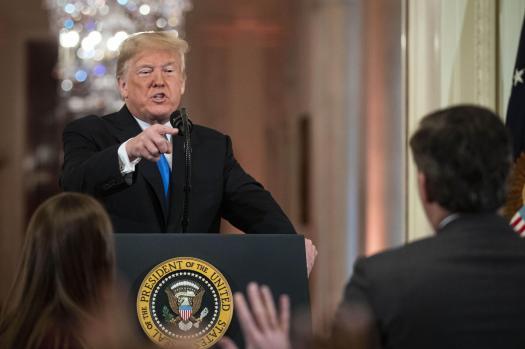
Homepage photo credit: President Donald Trump rebukes CNN reporter Jim Acosta during a news conference at the White House in Washington, D.C., on Nov. 7, 2018. Bloomberg photo by Al Drago
Joel Kotkin is the Roger Hobbs Distinguished Fellow in Urban Studies at Chapman University and executive director of the Houston-based Center for Opportunity Urbanism. He authored The Human City: Urbanism for the rest of us, published in 2016 by Agate. He is also author of The New Class Conflict, The City: A Global History, and The Next Hundred Million: America in 2050. He is executive director of NewGeography.com and lives in Orange County, CA. His next book, “The Coming Of Neo-Feudalism,” will be out this spring.