Reparations and the Racial Republic
America was conceived with the highest ideals about humanity — “all men are created equal” — but operated also as a racial republic, where rights were delineated by race, leaving only white males with the full set of powers. After all, Thomas Jefferson was also an owner of slaves.
The ensuing legacy of slavery and overt discrimination have led some to call for “reparations” for African-Americans. Essentially as we have gradually stripped away the shackles of that nasty past, some seem determined to bring it back.
We can see this not only in reparations demands, but also efforts to “race norm” admission to elite public schools, as in New York City, or to adjust the SAT scores along racial lines. This violates the basic idea that people should, in the words of Martin Luther King Jr., be judged not on their race, but on content of their character.
In academia it is increasingly common, as Harvard College’s dean Rakesh Khurana told graduates recently, that individual achievement is seen as less important than the “dynastic” forces of race. This underpins the notion that students “of color” need to be treated differently than others. This follows from the notion that “group rights,” not individual rights, are what matters. As one liberal observer noted, the West is “now inculcating in a new generation ideas where the whole concept of an individual who exists apart from group identity is slipping from the discourse. The very Enlightenment principles that underlay the liberal ideal are being largely cast away.”
The multiculturalism of the streets
Fortunately, these fashionable racial obsessions do not reflect the on the ground reality in most of America. Housing segregation, for example, has declined in most metropolitan areas, with the notable, and somewhat ironic, exception the most “progressive” cities such as San Francisco, Seattle and Portland.
Once restricted to barrios and ghettos, African-Americans, Latinos and Asians have been moving en masse towards the ever more integrated suburbs.
The racial Republic is losing ground with the masses of Americans. Today roughly 86 percent, according to one recent survey, of adult Americans do not believe European roots are necessary to be “truly American.” Two in three said they felt optimistic about breaching racial divides.
Culturally we have become ever more integrated. Despite the bizarre concerns of “cultural appropriation ,” Americans have gone from consuming bland Northern European fare to regular patrons of Italian, Jewish, and, most recently, Asian and Latino fare. If we are indeed, “what we eat,” we are a rapidly diversifying people.
Demographic realities
Given our changing demographics, it is difficult to see how a reparations regime would even be workable. Many African-Americans are more than descendants from African slaves; roughly one quarter of their DNA, according to one recent study, comes from Europe, Asia, Latin America or Native Americans. This is particularly true of places like Louisiana, where many African-Americans identify as mixed-race creoles and where a significant number — quarter of New Orleans population in 1830 — lived as free people before the Civil War.
More critically, the fastest growing part of the African-American population is from the Caribbean or Africa. Today, approaching one in ten African-Americans is an immigrant or their offspring; the number of such Americans has grown fourfold since 1970, and now accounts for over 3.7 million residents.
Racial bean counting will become even more difficult due to the remarkable rise of mixed race children, which, notes Pew, has almost tripled to 14 percent since 1980; it is roughly 20 percent in California, and well higher in both red Alaska and blue Hawaii. This will increase in the future as 17 percent of all marriages are now interracial.
The real issue is class
It is often suggested that since other groups have received reparations — such as Japanese Americans forced into concentration camps in the Second World War — that African Americans should get them too. But those went to the actual victims, not their offspring. Today’s African Americans are a century and half from slavery, and nearly a half century from the worst impacts of Jim Crow.
Racism, to be sure, remains a problem, but as Bernie Sanders has correctly noted, the real issue is class. The strongest case for reparations is based on economic disparities, but neither poverty or lack of upward mobility are primarily racial in nature. The plurality of poor people in America are white, even though Latinos and African Americans suffer poverty at higher rates. More relevant issues — family breakdown, globalization and de-industrialization, high housing and energy prices, and, ironically, some argue, mass immigration — generally transcend race.
In addressing this more permanent divide, that of class, reparations bark up the wrong tree, at least political. Barely one in four Americans, and only a small portion of whites, supports reparations, one reason why in 2016 Barack Obama, Hillary Clinton and Bernie Sanders opposed them. Now most leading party candidates, pandering for left-leaning voters in the Democratic primary, seems to be largely “all in” for reparations, not a promising position for the general election.
The real focus must be not on symbolism but economic growth, community and family stability. Having a black President may have been a deservedly proud moment for African Americans, but arguably they, and other minorities, may be doing better under President Trump.
This is not to imply that Trump, with his brutal rhetoric and calculated insensitivity, represents a good model for addressing racial issues. But if he is to be defeated, the emphasis should be on those issues — health care, lower taxes on working people, greater economic growth — that lift people of all races out of poverty and propel them into the middle class.
Given the larger portion of minorities in this position, such an emphasis on such policies would help minorities but would do so without excluding everyone else. Americans want a fairer, more equitable America. Restoring the bad days of the racial republic — where people are defined by their ethnicity, not their character — is not the best way to get there.
This article first appeared on The Orange County Register.
Joel Kotkin is the Roger Hobbs Distinguished Fellow in Urban Studies at Chapman University and executive director of the Houston-based Center for Opportunity Urbanism. He authored The Human City: Urbanism for the rest of us, published in 2016 by Agate. He is also author of The New Class Conflict, The City: A Global History, and The Next Hundred Million: America in 2050. He is executive director of NewGeography.com and lives in Orange County, CA.
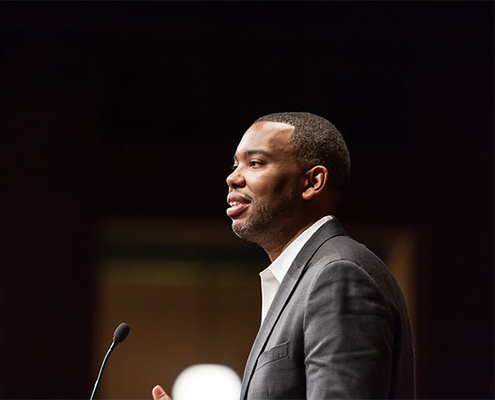
Photo: Ta-Nehisi Coates. Credit: Gerald R. Ford School of Public Policy, University of Michigan, via Flickr, using CC 2.0 License.