Purpose, order, nature as organizing principles of humanized cities
This article first appeared at Saudi Gazette
Day three of the Humanizing Saudi Cities conference in Madinah took a distinctly philosophical turn and focused on the principles that both have been and should be applied to city planning. The apparent gulf that opened between what planners think citizens should have and what the citizens want, even if they are unable to vocalize it, is considerable. However, speakers argued, planners are beginning to appreciate and understand how people work and live in cities and positive changes are taking place.
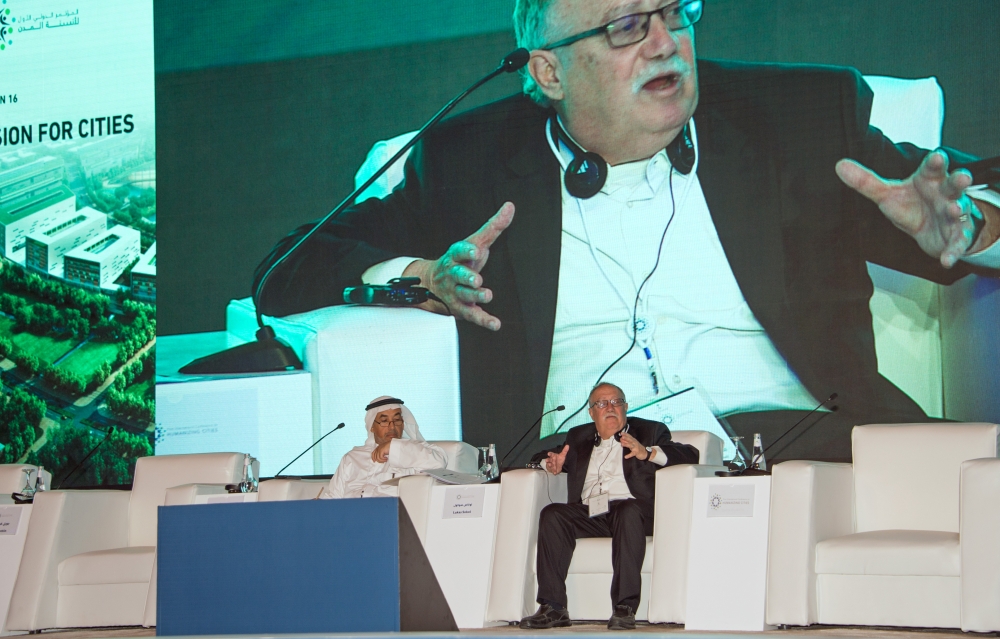
The principles of the beneficial effect of greening cities has been long known, said Joel Kotkin, author of ‘The Human City; Urbanism for the Rest of Us’. Quoting Aristotle he identified what he believed was the starting point for planning; “A city comes into being for the sake of life; it exists for the sake of living well.”
Using the UK example of the industrial revolution, he described the atrocious conditions that existed when industry and living were melded as a unit. Health, mental and spiritual well-being were downwardly affected. Worse still, the rise of industry too labor out of homes and organized it into factories.
He cited Ebenezer Howard, a British parliamentary secretary who founded the first garden city — Letchworth — in the early 20th century and which has been a model for city planners ever since. “Town and country must be married and out of this joyous union will spring new hope, a new life, a new civilization,” Howard said.
“We don’t want to live the way planners say. It has a madcap logic but no human logic,” averred Kotkin, adding that the megacity is a failure and a new urban model is required, noting that there was a proven correlation between city population density and fertility in all the studies mad globally.
Asking the question “Where do people want to live in five years?” he answered with a survey that revealed that 28 percent wanted a rural surrounding, 50 percent suburban and only 22 percent urban (city centers).
Meanwhile, restorative measures could be taken in existing cities and the same methods used in planning new ones. Kotkin gave examples as; good design using less water and energy; use ancient Middle-East designs of low-rise housing and gardens to improve cooling and increasing homeworking to reduce transport pollution.
Eng. Al Shuabi, co-founder of Beaah Architects, identified the motorcar as a principle cause of the radical change in city design. “It has destroyed the traditional urban structure and social fabric of commerce and has created divisions that have no social value,” he said. He showed startling images taken 10 years apart of city centers to support his claim.
Al Shuabi echoed a recurring theme of the conference that ‘urban spaces should reflect the needs of the people, allow for multiple activities, respect cultures and allow access for all,” he said. First among a list of essential features he presented for a successful urban space was to resolve the conflict between car and pedestrians, by creating efficient public transport and a pedestrian network.
“All this should be in a very attractive, inspiring and innovative design that nourishes the human spirit,” he concluded.
For inspiration, suggested Rasem Badran, Founding Principal of DAO, International, we should look at the chaos and order of the natural world. His presentation vividly illustrated his work using the chaos of natural forms that adapted to their environment, such as watercourses and vegetal growth patterns, and how they could be adapted to enhance the human habitat. The subtle integration bringing livable order out of chaotic natural design was, he thought a demonstrably valuable tool to structuring an amenable human environment.
Dr. Maher Stina, principal of Sites International, quoted a 17th century Arab visitor’s reaction to Delhi as a guiding principle; “It is a garden that is inhabited.”
He compared that with modern Cairo by noting that the population/open space ratio was only 35 square centimeters for each person. He suggested that open spaces could be created using existing redundant topographical features; wadis and land fill sites for example. One such site, Al Azhar Park in Cairo, he noted, as a fine example of such land use.
Lukas Sokol, of the department of Urban Planning in Abu Dhabi, explained how the principles of basing communities on human needs and expectations had been applied to planning.
He worked on the fundamental parameters of respect, religion, culture and values of the people who were to use the communities and to develop initiatives to guide the planning. That understood, a workable structured plan involving those parameters at the core was essential so that the humanizing of the community came about in the execution of the plans.
“We put all the values and the initiatives together and built individual communities and to encourage relationships between them,” he said. “Combining environmental, economic, social and cultural values in the vision and the planning leads to multiple benefits for the residents,” he concluded.
The outcomes of the conference have been a clarification to the guests of what exactly the term humanizing means in city planning and a very lively sharing of ideas and viewpoints that will hopefully enter mainstream planning in the Kingdom.