

Why the Fourth of July is Relevant to Canada, Too
The United States approaches its 250th anniversary deeply divided. Pride in the country, at roughly 40 per cent, has dropped to a historic low, notes Gallup, a trend most evident among younger, educated people.
To be sure it depends where in the U.S. you go. There used to be little difference between the parties, as was evidenced in the 1976 centennial. But, again predating Donald Trump, the gap between Republicans and Democrats has widened, with the latter generally not proud of their country. In deep blue areas like California and New York, celebrations are muted; even the traditional Fourth of July fireworks show in Long Beach, Calif., has been cancelled. Don’t expect much celebratory treatment in left-dominated Hollywood either.
No doubt these phenomena will please some Canadians, for whom hostility to America has created a kind of negative sense of identity. After all, they, and most European countries, are still considerably less patriotic than Americans.
A key factor in the diminishment of patriotism lies with an education system, in almost all western countries, that stresses western nations’ perfidy. In academia, history has been reduced to the paradigm of a settler-colonial mantra that essentially sees former colonies, as well as former colonial powers, as inherently illegitimate.
These views have penetrated our culture to an astounding degree. In Canada, allegations of unmarked graves containing First Nations children at the site of a former residential school have been largely debunked, but not in the eyes of most media. Rather than celebrate Canada’s great achievement of providing a better life for millions of immigrants, the new mentality states that the country, like the U.S. or the U.K., is fundamentally evil and illegitimate.
This kind of thinking defines the cultural elites in both countries. Stars like Billie Eilish routinely claim that “no one is illegal on stolen land,” although I doubt she plans to hand back her manse to the Tongva, the original inhabitants of Los Angeles.
To be sure there is much ugliness in the past of all nations. America’s embrace of slavery in the South and often brutal treatment of Indigenous populations need to be acknowledged, as should the arguably more muted, but also repressive, attitude of Canadian governments towards its First Nations.
But pride in country is important, even more so as both of our societies become dominated by more recent immigrants from primarily non-western countries. Unless you embrace the notions of the global socialist commonwealth, our sense of identity is tied to our embrace of a past we all can honour.
The intellectuals and artists who demean western civilization have a particularly toxic impact on newcomers from autocratic lands. Muslims, notes the Manhattan Institute’s Reihan Salam, may not come here radically anti-western, but their children’s exposure to the current academic and media culture has bred hostility to the West. This is evident in the numerous antisemitic rallies, particularly in Canada, as well as the rise of young, affluent, educated cosmopolitans like Hasan Piker and New York’s new boss, Zohran Mamdani.
The 250th anniversary is also a good time to recognize, and maybe celebrate, the fundamental differences between our countries. America emerged as a revolutionary power that emboldened many peoples to rebel against monarchism; there were even some Canadians swept up in what historian R.R. Palmer called the age of “democratic revolution.”
Read the rest of this piece at Yahoo News.
Joel Kotkin is the author of The Coming of Neo-Feudalism: A Warning to the Global Middle Class. He is the Roger Hobbs Presidential Fellow in Urban Futures at Chapman University and and directs the Center for Demographics and Policy there. He is Senior Research Fellow at the Civitas Institute at the University of Texas in Austin. Learn more at joelkotkin.com, follow him on Substack and Twitter @joelkotkin.
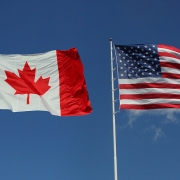
Homepage photo: Ben Grewell via Flickr under CC 2.0 License.











 Public Domain