

Whatever Happened to the Great West Coast Cities?
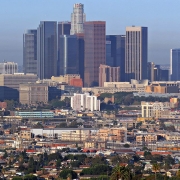
As recently as the early Nineties, when the great cities of the Midwest and East Coast were careening toward what seemed like an inevitable downturn, the urban agglomerations along the Pacific coast offered a demonstrably brighter urban future. From San Diego to the Puget Sound, urban centers along America’s western edge continued to thrive and expand as migrants from other parts of the country, and the world, crowded in.
In the process, the Pacific cities seized the economic initiative. The West Coast became home to the country’s premier trade entrepôt and its dominant entertainment and technology centers, and home to five of the world’s six most valuable companies.
Yet now these same cities — despite differing histories and industrial mixes — face a precipitous decline. Never before have all the burgeoning cities of the future, Los Angeles, San Francisco and Oakland, started to shrink. This is, at least in part, a reaction to high prices, relentless property crime, homelessness — San Francisco’s rate of homelessness, for example, is twelve times the national average — and diminished economic opportunity, particularly for the middle and working classes.
At the same time, big companies like Tesla, Oracle, Hewlett-Packard, Jacobs Engineering, Fluor, Bechtel and McKesson have moved headquarters; others are shifting their operations elsewhere, largely to more business-friendly and less costly regions in Texas, Arizona, Nevada, Florida and Tennessee. Hundreds of other less notable companies, most paying above average wages, have also gone east and south.
The largest US economies are increasingly located in the sunbelt states, which are fast becoming the prime locations for Fortune 500 companies, with Houston and Atlanta in the top three after New York. But Southern states, including Georgia, Louisiana, Florida and Texas, also dominate the list of most small businesses per capita. This is not simply a shift of low-wage jobs; according to the forecaster Lightcast, it includes manufacturing as well as business and professional services, the largest high-wage sector.
America’s urban woes aren’t limited to the West Coast, of course. But the decline there has generally been steeper than elsewhere. Why? How did such golden cities get so tarnished, so quickly? Unlike in the tragic case of the Midwest, the answer is not reliance on declining industries: tech, space, entertainment continue to show promise and could propel growth for decades. Instead, the damage has been remarkably self-inflicted, reflecting the reckless growth of a set of progressive dogmas, tough on police and permissive toward criminals and vagrants while imposing ever more burdens on what is left of the middle class.
The results of these policies are particularly evident in tech-rich San Francisco, where decades of tolerance for even extreme deviant behavior has helped create a city with more drug addicts than high school students; little wonder it ranked last in the US for efficiency in a recent WalletHub survey. In Southern California’s far more proletarian city of Los Angeles, a UN official last year compared conditions on downtown’s Skid Row to those in Syrian refugee camps. Like Los Angeles and San Francisco, Oakland, Portland and Seattle show some of the highest per capita rates of homelessness in the country.
San Francisco may grab the headlines, but perhaps nowhere is the political change more notable than in Los Angeles, a city I moved to in 1975 and my home until seven years ago. Back then LA, in contrast to places like New York, was what the late Fred Siegel described as “the capitalist dynamo,” brimming with new companies not just in entertainment or aerospace, but in fashion, where it was the production leader, as well as in trade and scores of smaller niche businesses, many of them run by on-rushing immigrants and escapees from east of the Sierra.
This ebullient economy existed not only under conservatives like Sam Yorty but under Tom Bradley, his African-American successor and a former cop. Like previous mayors, Bradley, particularly in his first two terms, embraced traditional growth strategies, expanding the city’s port, investing in roads and bridges, bolstering its large industrial base. LA saw itself as the city of the future — and with good reason.
Read the rest of this piece at The Spectator.
Joel Kotkin is the author of The Coming of Neo-Feudalism: A Warning to the Global Middle Class. He is the Roger Hobbs Presidential Fellow in Urban Futures at Chapman University and Executive Director for Urban Reform Institute. Learn more at joelkotkin.com and follow him on Twitter @joelkotkin.
Homepage photo credit: Daniel Lawrence Lu via Wikimedia under CC 4.0 License.

 Gage Skidmore, used under CC 2.0 License







![African American children learning about Thanksgiving, with model log cabin on table, Whittier Primary School, Hampton, Virginia. Photograph by Frances Benjamin Johnston, [1899 or 1900].](https://joelkotkin.com/wp-content/uploads/2023/09/Thanksgiving-80x80.jpg) Library of Congress, in Public Domain
Library of Congress, in Public Domain Gage Skidmore, used under CC 2.0 License