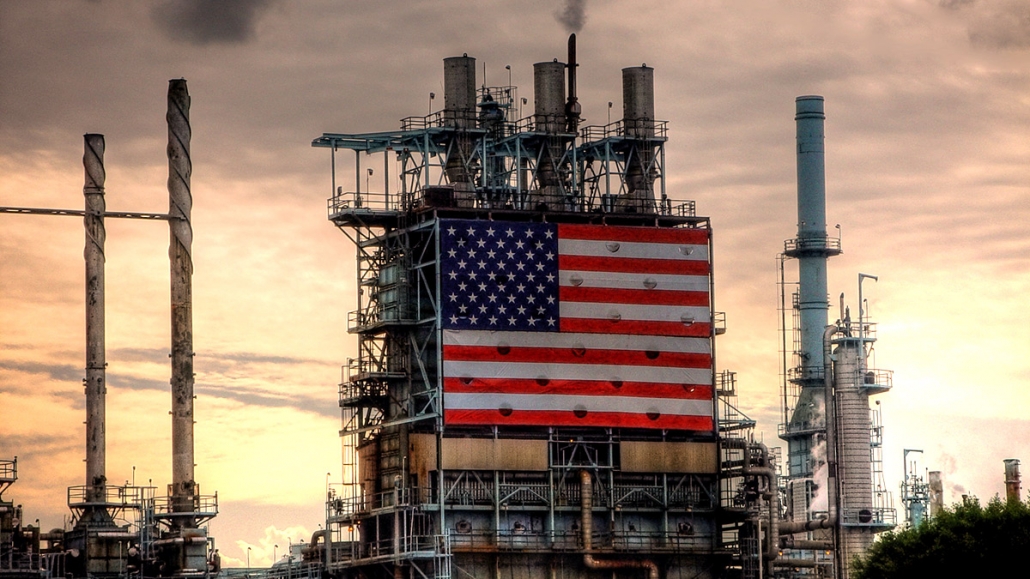
 Nikolas Zane, used under CC 2.0 License
The Myth of the Post-Industrial Economy
The cancellation of Donald Trump’s tariffs cannot stop what is a painful, but potentially gainful, reindustrialisation of America. Leadership across both parties – excluding the libertarian fringe on the right and the socialists on the far left – supports such a step, and the vast majority of Americans favour the large-scale reshoring of industry, primarily from China.
Yet wanting something and getting it are two different things. In the US, and much of the West, there is immense inertia favouring the continuation of offshoring, particularly to China and its satellites. Wall Street, based in a thoroughly deindustrialised New York, has traditionally embraced offshoring. Similarly, Silicon Valley, the other node of power in America, has followed suit, led by megafirms like Apple and Nvidia.
The idyll of a post-industrial economy – the idea that countries can thrive without producing tangible goods or even providing jobs – has proven disastrous. Between 2000 and 2007, the US haemorrhaged 3.4million manufacturing jobs, about 20 per cent of its total, and lost a further 1.5million manufacturing jobs between 2007 and 2016. From 2004 to 2017, the US share of world manufacturing shrank from 15 to 10 per cent, while reliance on Chinese imports doubled, even as Japan’s and Germany’s reliance on Chinese goods shrank.
The time for an industrial renaissance is now. As China ramps up its use of its own prodigious resources in pursuit of technological supremacy, the growing centralisation of power in the hands of the Chinese Communist Party is prompting some European and US firms to get out and return home. Including Asian and other foreign firms, UBS projected in 2020 that 20 to 30 per cent of all Chinese manufacturing capacity could move out of China this decade. Out of $2.5 trillion of Chinese exports, this would imply $500 billion to $750 billion moving elsewhere, particularly to the large market in North America.
All this predates Trump’s zany tariff Blitzkrieg. Over the past decade, some major companies – such as Black & Decker, Whirlpool, General Electric, Apple, Caterpillar, Goodyear, General Motors and Polaris – have already begun shifting their production footprints (with varying degrees of success). In 2019, for the first time in a decade, the percentage of US-manufactured goods that were imported fell, according to a 2020 Kearney study, with much of the shift coming from East Asia.
Perhaps the most promising sign is the recent movement among the so-called tech bros, who are increasingly keen on domestic production. In places like El Segundo, Long Beach and Austin, a ‘deep tech’ revolution is afoot, focussed on aerospace, quantum computing, biotechnology, advanced materials and autonomous systems. Instead of deepening the social-media sinkhole, they are building tangible products that could both protect the country and enrich its people.
Read the rest of this piece at Spiked.
Joel Kotkin is the author of The Coming of Neo-Feudalism: A Warning to the Global Middle Class. He is the Roger Hobbs Presidential Fellow in Urban Futures at Chapman University and and directs the Center for Demographics and Policy there. He is Senior Research Fellow at the Civitas Institute at the University of Texas in Austin. Learn more at joelkotkin.com and follow him on Twitter @joelkotkin.
Photo: view of a large refinery in Carson, California near the Long Beach industrial corridor. Source: Flickr, under CC 2.0 License. Credit, Nikolas Zane.