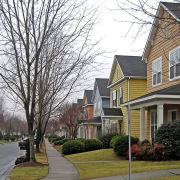
The Death of the Family Home is Killing the American Middle Class
Once renowned for widespread homeownership, the key Anglosphere countries are reverting to a feudal past, where land is owned by increasingly few. In every major market in Canada and Australia, and in much of America and the UK, house prices have skyrocketed to record levels, with corresponding consequences for home ownership rates.
In a new report, demographer Wendell Cox traces this to the failure to build enough new housing units, particularly the single-family homes that consumers most desire. In the United States, homebuilders built about one million fewer homes (including rental units) in 2024 than in 1972 when there were 130 million fewer Americans. One estimate puts the US housing market short by about 4.5 million homes.
But the housing crisis is a global phenomenon that hits the middle and working classes hardest. In large part due to high housing prices, notes the “OECD in Under Pressure: The Squeezed Middle-Class”, the middle-class faces ever rising costs relative to incomes, so much so that its very survival is threatened. “The cost of essential parts of the middle-class lifestyle have increased faster than inflation,” it notes. Housing prices have been rising “three times faster than household median income over the last two decades.”
Even in prosperous and communitarian Switzerland, Zurich studios sell for well over $1 million, and small houses for considerably more than that. Even affluent people cannot afford down payments, despite the overwhelming financial advantages to homeowners.
This housing shortfall and high prices are seen throughout the Anglosphere. Australia’s historically high rates of homeownership have all but collapsed among those aged between 25 and 34 years old, plummeting from more than 60 per cent in 1981 to only 45 per cent in 2016. The proportion of owner-occupied housing has dropped by 10 per cent in the last 25 years. In the United Kingdom in 2022-23, 39 per cent of 25-34 year-olds owned their home, compared to 57 per cent of the same age cohort in 1995. A rising proportion of British millennials are likely to remain renters for life.
Similarly, US millennials were already less likely in 2015 to be homeowners than baby boomers and Gen-Xers. By 2021, home ownership among those aged 25-34 had dropped from 45.4 per cent in 2000 to 41.6 per cent. Record numbers of first-time buyers are stuck on the sidelines as housing affordability stands at the lowest level for which there are data series, while one in three pay over 30 per cent of their income in mortgage or rent.
Across the board, Wendell Cox’s new report lays the blame for this situation on the British-born idea of urban containment, with its roots in the UK’s 1947 Town and Country Planning Act. This policy sought to steer development towards higher density core cities and away from the lower density periphery, forcing people into “living smaller, living closer” – whether they like it or not.
The results have been dreadful. As early as the 1970s, British planner Peter Hall suggested that the “speculative value” of land with planning permission in the UK was five to 10 times higher than that of land without planning permission. Virtually all the most expensive markets in Cox’s new affordability study – outside number one Hong Kong – operate some form of urban containment, including such cities as Vancouver, Sydney, Melbourne, Adelaide, San Francisco, Los Angeles, San Diego and, of course, London.
All these areas now have prices that are nine times or more higher than median incomes, which is also three times the historic rate. Many of the markets closer to that historic norm – in Texas, the South and the Midwest US – do not have such policies.
Nor does focusing on higher density lower prices, as is sometimes argued. In fact, US data suggests a positive correlation between greater density and housing costs. Among 53 major metros, those with more single-family housing and larger lot sizes (key indicators of lower density) have substantially better housing affordability. One recent study found that the median family in San Jose would need 125 years (150 in Los Angeles) to save a down payment; in Atlanta or Houston the figure is 12 years.
Perhaps most damning, these policies are clearly not effective in creating more housing; Portland, a US pioneer in urban containment, embraces high density housing but high prices have driven multi-family construction to the lowest level in a decade. In California, which has experienced similar stagnation, notes a recent RAND study, policy-driven delays, strict architectural standards, green mandates and the requirement to pay union-level wages have pushed the cost of construction of subsidised apartments twice as high as in Texas.
How do we begin to solve this problem? It should not be too difficult, once urban containment and other policies are effectively scrapped. With relatively low population growth – particularly outside the migrant population – there is no huge spike in fundamental demand as occurred, for example, in the 1950s and 1960s. The rise of remote work, migration to smaller urban areas, as well as new technologies for building, including the use of 3D printers, actually offer the chance to build more affordable housing.
The bad news is that this crisis is largely self-inflicted. The good news is that it can be solved, if our political class can find the will to change and jettison policies that have led to this disastrous situation.
This piece first appeared at: Telegraph.
Joel Kotkin is the author of The Coming of Neo-Feudalism: A Warning to the Global Middle Class. He is the Roger Hobbs Presidential Fellow in Urban Futures at Chapman University and and directs the Center for Demographics and Policy there. He is Senior Research Fellow at the Civitas Institute at the University of Texas in Austin. Learn more at joelkotkin.com and follow him on Twitter @joelkotkin.