Can Space Save Earth?
The world economy is in the doldrums, pessimism is rife around the world, and most young people, according to one survey, believe climate change means the end of human life on Earth.
Yet a better future beckons, if we can only begin to look outside ourselves, and even beyond our planet. It is in space that we may find solutions to some of our most pressing problems, including a workable energy strategy and access to the precious minerals needed to sustain our prosperity.
Space has always held a special place in our collective imagination. Missions to Mars, the mining of asteroids and the development of space-based human societies have been the subject of TV shows and movies for decades, all speaking to the notion of a human “manifest destiny” that will transcend the inertia of our Earth-bound society.
Despite a decades-long torpor at NASA, the space industry is making a major comeback. The U.S. Bureau of Economic Analysis has just announced that it is formally tracking the industry’s growth, which it estimates contributes approximately $200 billion annually to the U.S. economy and already employs 354,000 people. The global space economy could reach $1 trillion by 2040, according to new research from Morgan Stanley.
This rapid growth reflects not so much the desire to “boldly go where no one has gone before” but — as in the westward expansion across America of the 19th century — our hunger for riches, precious metals and minerals. It has less to do with exploratory zeal and more with maintaining and feeding our terrestrial habitat.
In this quest, government is still a large part of the effort — with serious players including nations as diverse as China, Russia, India, Japan and Israel. NASA, for its part, has spent five years building the Artemis moon exploration program.
But increasingly, today’s return to space is being driven by private sector innovation and for-profit companies, which made 2021 the best year for space growth in decades.
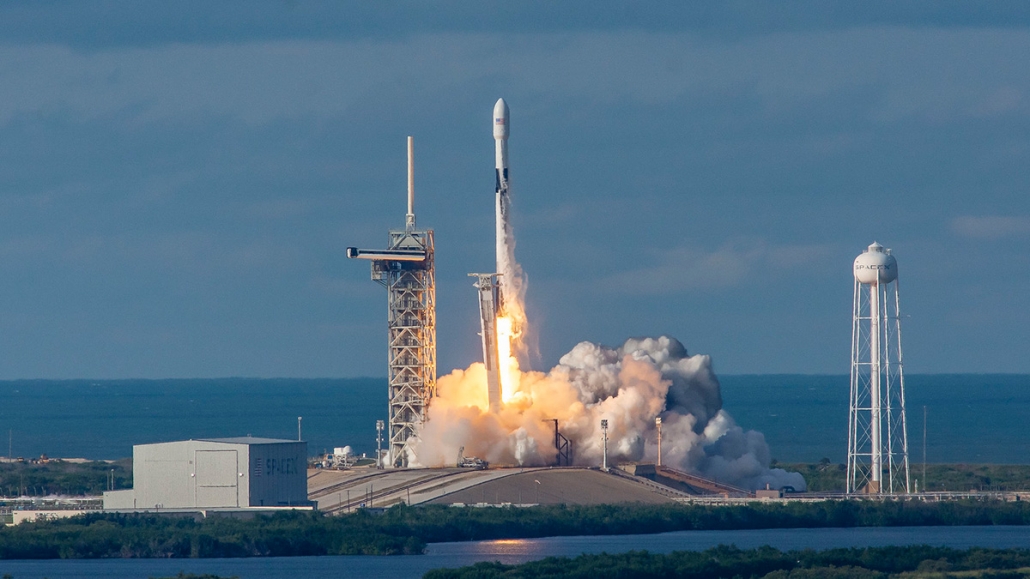
The dominant players now are firms like SpaceX, Relativity, Virgin Galactic, Blue Origin and Long Beach-based Rocket Lab, which has recently announced a new mission to explore the gases of Venus. A recent report from the not-for-profit Space Foundation noted that about 90% of the more than 1,000 spacecraft launched this year have been backed by commercial firms — most notably the hundreds of Starlink internet satellites launched by Elon Musk’s SpaceX. The pace of new launches is now the greatest since the late 1960s during the U.S.-Soviet “race to the moon.”
SpaceX dominates today, accounting for upwards of 60% of all new commercial rocket launches. The company has achieved major technological breakthroughs in recent years, dramatically lowering the cost of spaceflight. Sending people or cargo into space, measured per kilogram, is 85 times cheaper today than when the space shuttle first launched in 1981.
SpaceX is preparing to establish a permanent presence on the moon and launch a crewed mission to Mars, but other players are also driving change. NASA, for instance, is planning new unmanned deep-space exploration. Japan has already started small-scale efforts to test the feasibility of retrieving metals from asteroids, the first attempt to shift mining away from our fragile planet to the vast and, as far as we know, empty areas in space.
These activities are already helping Earth in profound ways. Perhaps the most evident benefit has come in the form of satellite communications. SpaceX, through its Starlink constellation of satellites, beams broadband service to customers around the globe.
The efforts of space companies to provide orbital communications networks have, among other things, begun to bring cyberspace to the developing world. Aerospace engineer and consultant Rand Simberg says the Starlink system is why “Ukraine has maintained the internet through the war.” Sadly, the U.S. government recently rejected a Starlink project to serve rural America.
Read the rest of this piece at Los Angeles Times.
Joel Kotkin is the author of The Coming of Neo-Feudalism: A Warning to the Global Middle Class. He is the Roger Hobbs Presidential Fellow in Urban Futures at Chapman University and Executive Director for Urban Reform Institute. Learn more at joelkotkin.com and follow him on Twitter @joelkotkin.
Marshall Toplansky is a widely published and award-winning marketing professional and successful entrepreneur. He co-founded KPMG’s data & analytics center of excellence and now teaches and consults corporations on their analytics strategies.
Photo: SpaceX via Flickr under under CC 2.0 License.
 Daniel Oberhaus, used under CC 4.0 License


 SpaceX, used under CC 2.0 License