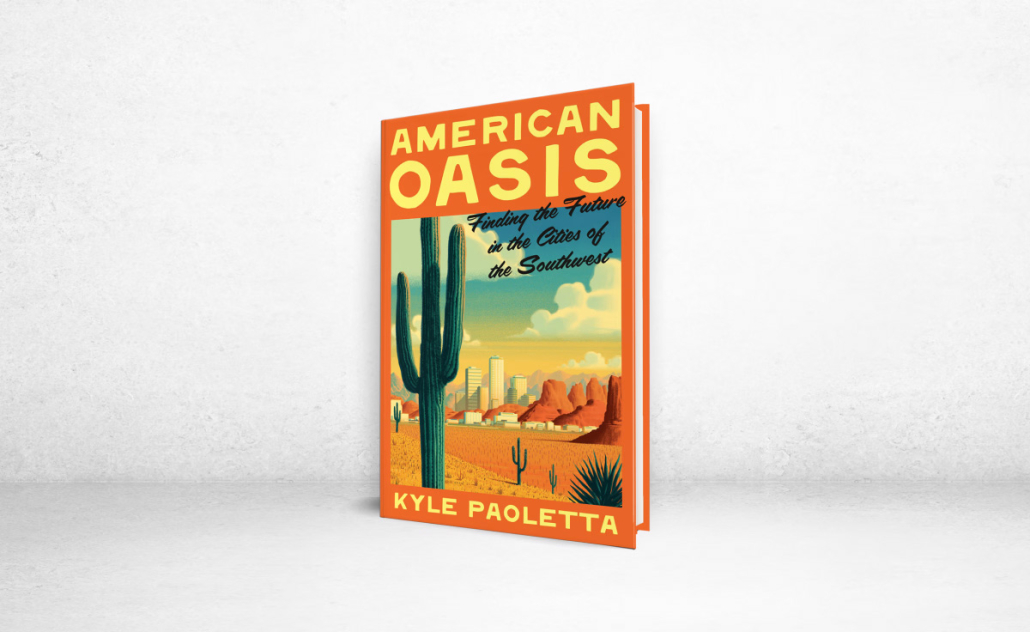
‘American Oasis’ Review: The Lure of the Desert
Hating the Southwest, particularly its burgeoning cities such as Phoenix, is de rigueur in American media. Jon Stewart has called Arizona “the meth lab of democracy.” Hunter S. Thompson described hell as an “overcrowded version of Phoenix.” Fran Lebowitz, the epitome of New York progressive arrogance, said: “I don’t think anyone needs Arizona. . . . Putin: here take Arizona, leave Ukraine.”
It’s a tendency that Kyle Paoletta rightfully finds annoying. In “American Oasis,” Mr. Paoletta, a journalist and critic, focuses on the region spanning California to Texas and argues that the Southwest, if not a mistake, is poised for ecological and social dislocation.
Having grown up in Albuquerque, N.M., the son of affluent professionals, Mr. Paoletta now questions whether newcomers “who have sought to master the Sonoran Desert with air conditioning and aqueducts” can really call the region home.
Yet these are precisely the people who continue to migrate to this supposedly miserable corner of the continent, building what amounts to a new America. Budding sophistos such as Mr. Paoletta may move to the dank Northeast, but since 2010 Arizona’s population has grown by more than one million—the eighth-fastest growth among U.S. states. More than two-thirds of that growth has been attributable to people moving to Arizona from other states, primarily far-more-temperate California.
The reasons are clear. These migrants are not coming to exploit cattle, cotton or copper but to find opportunities in industries, such as aerospace and semiconductor manufacturing, that were once dominated by California. Exploiting the indigenous population is not high on the agenda of someone moving from Los Angeles or Long Island, N.Y. In most cases, their contact with native peoples is limited to the casinos.
Nor are the newcomers uniformly ignorant or unskilled, as many on the coasts would believe. California and New York may be hemorrhaging recent college graduates, but Las Vegas, Phoenix and Tucson—once seen as retirement cities—are now attracting more people, especially millennials, who are ready to buy homes and start families.
Mr. Paoletta’s narrative also misses the fact that many people moving to the Southwest are themselves minorities. He only has eyes for the activists and the cultural rebels—the advocates of Chicanismo, for instance, or the National Welfare Rights Organization and Black Lives Matter—who complain about the encroachments of the diverse newcomers. His focus is not on the upwardly mobile minorities but the “Latino and Indian underclass living without utilities along gravel roads.”
It’s not surprising, then, that Mr. Paoletta praises the “sanctuary movement,” even though most Americans, including many Latinos, were not so happy with the Biden open border. Somehow the pushback against unvetted mass migration missed the author except as proof of racism. In his view, the promise of equal rights and opportunities offered by the Statue of Liberty is “illusory” and immigration status should not matter.
In reality, despite the hoary racist past, minorities are moving en masse to Arizona and other Southwestern areas. Most either choose or hope to settle in the suburbs. Rather than fighting “the man,” they are more likely to look into how they can become him and have more in common with their middle- or working-class white neighbors than the professional ethnic progressives.
Typically, Mr. Paoletta despises master-planned communities. But these are the places where many minorities reside or hope to reside. More than 95% of all U.S. suburban growth since 2010, notes Wendell Cox, a demographer, has been driven by people of color — hardly fodder for a woke revolution. Almost half of Latinos in Arizona voted for Donald Trump. As the number of second- or third-generation Southwesterners increase, they could easily move further to the right, as is already happening in Texas.
“American Oasis” quite rightly closes with a discussion of water. As the old saying goes, “whiskey is for drinking; water is for fighting over.” Ever since the Hohokam people settled in Arizona some 2,000 years ago, growth and survival in the Southwest has been about access to water. Droughts are always a threat; one that occurred early in the previous century lasted a decade.
Mr. Paoletta regards the water issue as being related to “climate,” although it’s long been obvious that the region would have to learn to live with less. The author correctly salutes efforts, both in Phoenix and Las Vegas, to curb per capita water consumption, but then denounces dispersed developments and favors density. Never mind that steel-and-glass towers create a heat-island effect, generating more heat than low-rise landscaped development.
Discussions of climate issues have become a distraction, a barrier to addressing the region’s real challenges. Mr. Paoletta, for instance, rejects the idea of desalinization, something that has been impactful in other dry regions, notably the Middle East.
Yet there are reasons to be hopeful. As the region grows, Southwestern culture will evolve. The treatment of ethnic minorities in the past may have been horrendous, but that’s only part of the story. The days of quasiracist politics in these states have largely passed; Arizona, Colorado, New Mexico and Nevada repeatedly send left-leaning senators to Washington. Mr. Paoletta concedes the region is becoming “a pluralistic society already in full flower.” Today you can find Turkish or Vietnamese food in Tucson, a city once known largely for taco and burger joints.
The Southwest has many problems. But it is also where millions of Americans are forging the nation’s future. Multiracial suburbs are eclipsing ghettos and reservations. New ways of building houses and communities to deal with heat and water conservation are emerging. Rather than sunbaked oddballs or brutal exploiters, the people of the Southwest are creating a new multiethnic society in the desert. For this, they deserve a far more balanced depiction than found in “American Oasis.”
This piece first appeared at: Wall Street Journal.
Joel Kotkin is the author of The Coming of Neo-Feudalism: A Warning to the Global Middle Class. He is the Roger Hobbs Presidential Fellow in Urban Futures at Chapman University and and directs the Center for Demographics and Policy there. He is Senior Research Fellow at the Civitas Institute at the University of Texas in Austin. Learn more at joelkotkin.com and follow him on Twitter @joelkotkin.